Kimchi Gyeran Mari: Easy Korean Rolled Omelet
This post contains affiliate links. As an Amazon Associate, we earn from qualifying purchases at no extra cost to you.
Prep: 5 min · Cook: 10 min · Total: 15 min · Serves 2
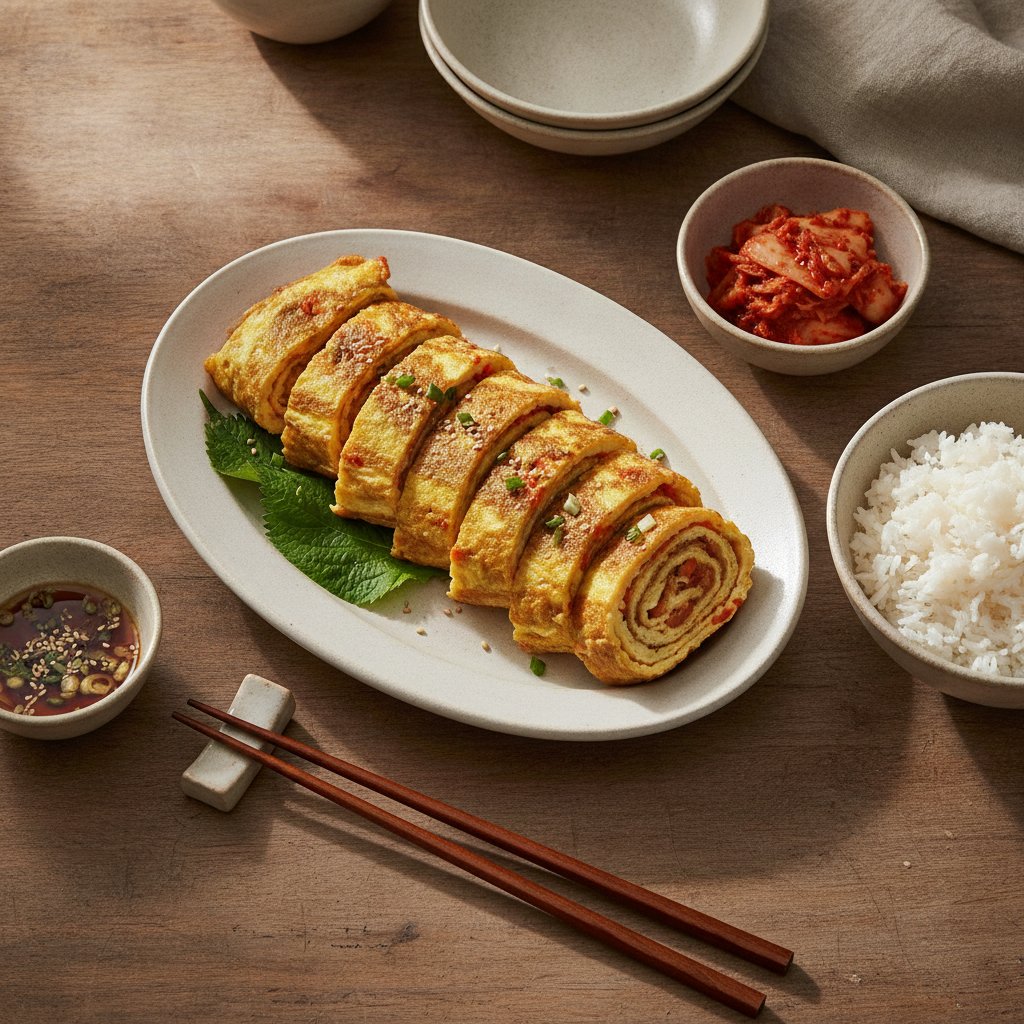
Late at night in Seoul, when the refrigerator looks sparse and energy is running low, my hand almost automatically reaches for two things: a jar of sour, well-aged kimchi and a carton of eggs. In Korean home kitchens, this combination is pure magic. While plain gyeran mari (rolled omelet) is a daily staple packed into school dosirak (packed lunchboxes) or served as a humble banchan (side dish) alongside stew, folding finely chopped kimchi into the golden layers changes everything. The tart, spicy crunch of the fermented cabbage cuts right through the rich, savory egg, creating a dish that feels both comforting and lively.
If you have ever ordered this at a Korean sul-jip (pub or drinking tavern), you know it often arrives on a sizzling hot plate, sliced into thick, cheerful ribbons that beg to be shared. The good news is that you do not need special street-vendor equipment or years of culinary training to pull this off on a Tuesday night. In my house, we make this in less than fifteen minutes using an ordinary nonstick skillet. The trick lies entirely in controlling your pan heat and prepping the kimchi so its juices do not render the eggs watery. Once you master the simple fold-and-pour rhythm, you will be rolling these with complete confidence.
Why This Works
- Drying and dicing the kimchi finely: Squeezing excess liquid from the kimchi before chopping keeps the egg mixture cohesive, preventing the delicate layers from tearing or getting soggy during rolling.
- Diluting proteins with liquid: Whisking a small splash of water or milk into the eggs relaxes the protein strands, yielding a tender, pliable roll that folds cleanly without cracking or tasting rubbery.
- Layered heat management: Cooking on low-medium heat and oiling the pan lightly between rolls creates smooth, golden seams instead of dry, brown patches.
Ingredients
- 5 large eggs (approx. 250 g / 8.8 oz total liquid weight)
- 80 g (about 1/2 cup) finely chopped, well-aged napa cabbage kimchi (baechu kimchi), squeezed dry
- 1 green onion (about 15 g / 0.5 oz), sliced very thinly
- 15 ml (1 tbsp) whole milk or water
- 1.5 g (1/4 tsp) fine sea salt
- 2 g (1/2 tsp) granulated sugar (adjust based on kimchi sourness)
- 2.5 ml (1/2 tsp) toasted sesame oil (cham-gireum)
- 15 ml (1 tbsp) neutral cooking oil (such as canola, vegetable, or avocado oil), divided
- Optional: 30 g (about 1/4 cup) low-moisture shredded mozzarella cheese or 1 slice of American cheese
Substitutions
If your local store carries limited Asian products, do not worry. Standard store-bought napa cabbage kimchi (brands like Cleveland Kitchen or Mother-in-Law’s, commonly found in Western supermarket produce aisles) works wonderfully. If your kimchi is fresh rather than sour, mix a drop of rice vinegar into the chopped cabbage to mimic the brightness of aged kimchi. For the liquid splash, simple cold water works just as well as milk, though milk gives a slightly creamier color. If green onions are unavailable, fresh chives or finely diced shallots make a great substitute.
🛒 Kimchi Gyeran Mari
As an Amazon Associate we earn from qualifying purchases.
Shop Ingredients & Tools →How to Make It
- Prep the kimchi filling: Take your aged kimchi and squeeze it over the sink or a small bowl to press out excess juice. Measure out 80 grams (1/2 cup), then chop it into small, uniform pieces roughly the size of rice grains. Squeezing out the liquid prevents the acid from curdling the raw egg and stops water pockets from bursting your omelet seams. Place the chopped kimchi in a small bowl and toss with 1/2 tsp of sugar and 1/2 tsp of toasted sesame oil. The sugar tempers harsh acidity, while the sesame oil adds a nutty aroma.
- Whisk the egg base: In a medium mixing bowl, crack all 5 eggs. Add 1/4 tsp of fine sea salt and 1 tbsp of milk or water. Whisk vigorously with a fork or balloon whisk until the yolks and whites are completely unified and no thick clear albumen streaks remain. Incorporating milk relaxes the tight egg proteins, making the omelet soft and pliable enough to roll smoothly without breaking.
- Combine egg and aromatics: Fold the seasoned kimchi and finely sliced green onions directly into the beaten egg mixture. Stir thoroughly so the solid ingredients are evenly dispersed throughout the liquid.
- Prepare the pan: Heat a small nonstick skillet (either an 8-inch round pan or a standard rectangular Korean egg pan) over low-medium heat for about 2 minutes. Add 1/2 tablespoon of neutral oil. Fold a paper towel into a small pad, hold it with tongs or your fingers, and wipe the oil across the entire surface of the pan. You want a thin, glossy film rather than a pooling puddle of oil, as floating in oil causes the egg to bubble and blister rather than form a smooth ribbon.
- Pour the first layer: Pour approximately one-third of the egg and kimchi mixture into the warm pan. Swirl the skillet gently so the liquid spreads out into an even, thin circle or rectangle. Lower the heat to low. Allow the egg to cook until the bottom is set but the top surface remains slightly tacky and moist, which takes about 1 to 2 minutes. If the top dries completely, the layers will not stick together when rolled.
- Begin the roll: Using a wide spatula or a pair of wooden chopsticks, lift the edge of the omelet closest to you and fold it over about 1 to 1.5 inches (2.5 to 4 cm). Continue rolling the egg forward in neat folds until you reach the far edge of the pan. Gently press down on the roll with your spatula for a few seconds to set the shape.
- Extend and add the second layer: Slide your rolled egg back to the edge of the pan where you started. If the pan looks dry, lightly wipe it again with your oiled paper towel. Pour another third of the egg mixture into the empty space of the pan. Lift the existing egg roll slightly with your spatula so the wet egg liquid flows underneath it. This connects the old roll to the new layer seamlessly. If using cheese, sprinkle it thinly along the warm top surface of the original roll right before making the next fold.
- Finish rolling: Once the second layer is set on the bottom but still soft on top, roll the initial log back over the new layer to the opposite side. Repeat the process one last time with the remaining third of the egg mixture. Keep your heat low throughout this step so the egg cooks evenly without browning.
- Shape and rest: Once the entire omelet is fully rolled, use your spatula to gently push the roll against the side of the pan to square off the edges. Turn off the heat and let the roll rest in the warm pan for 2 minutes. Transfer the rolled omelet onto a clean cutting board or a bamboo sushi rolling mat. Let it cool for at least 5 minutes before slicing. Resting allows the internal steam to cook the center through and firms up the structure so it won’t collapse under the knife.
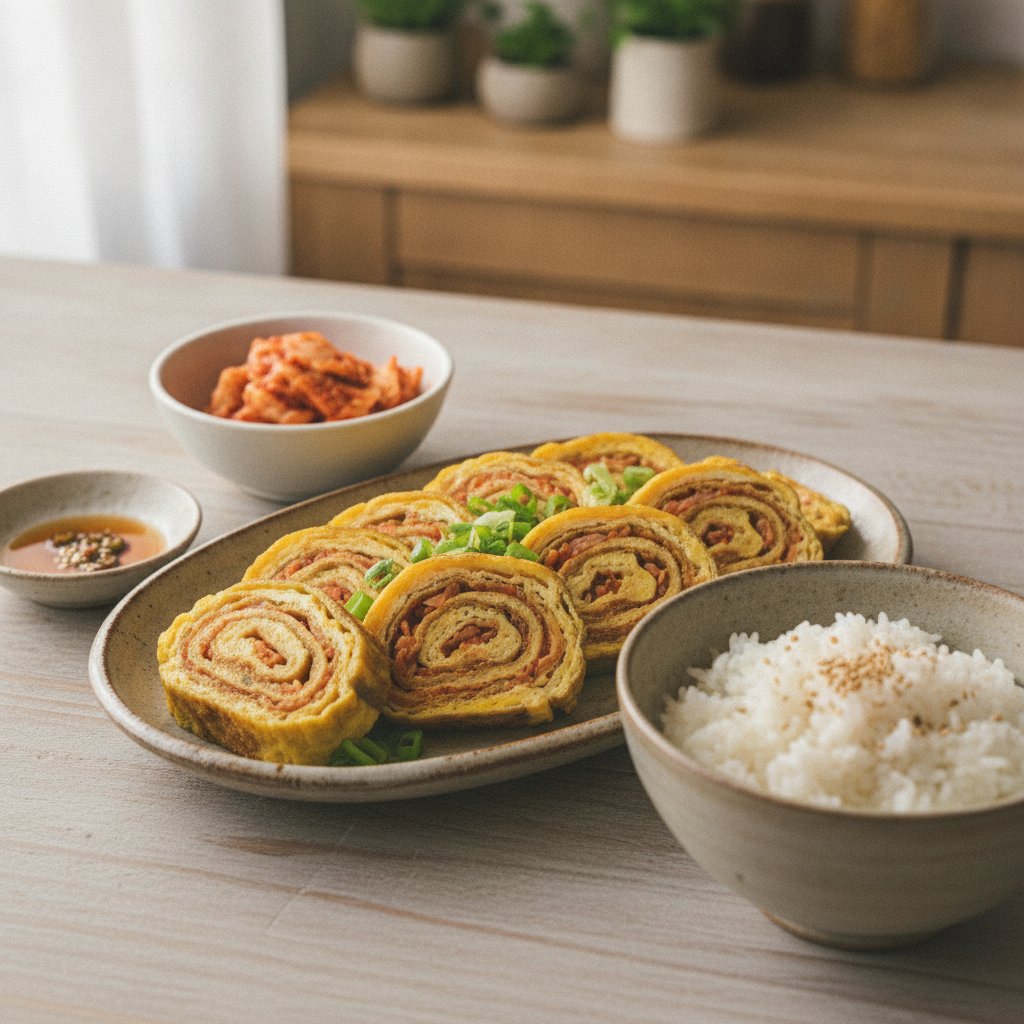
- Slice and serve: Using a very sharp chef’s knife, slice the roll into thick cross-sections, about 3/4-inch (2 cm) wide. Wipe your knife blade with a damp paper towel between cuts for clean, elegant slices showing distinct golden and red spirals.
Tips from a Korean Kitchen
The most common mistake beginners make with gyeran mari is rushing the heat. High heat causes eggs to expand with steam and turn rubbery, creating pockets of air that rip open when you try to fold them. Keep your flame strictly on low-medium to low. You want gentle, slow cooking so the egg remains supple like a sheet of crepes.
If you do not own a square rectangular egg pan (gyeran-mari-pan), do not feel obligated to buy one. A standard 8-inch or 9-inch round nonstick skillet works beautifully. When using a round pan, your first few folds will be narrower at the edges, but as you build the roll toward the center, it naturally squares off into a uniform log. You can simply trim the uneven ends off after slicing—and eat them as your cook’s treat!
Always remember the oiled paper towel technique. Drizzling oil straight from the bottle usually leads to excess grease, which fries the egg instead of steaming-and-searing it smoothly. The paper towel method coats every millimeter of the nonstick coating evenly without excess residual fat.
Storage
Kimchi gyeran mari keeps exceptionally well, which is why it is such a popular item for meal prep and lunchboxes across Korea. Place leftover sliced omelet pieces into an airtight container and store them in the refrigerator for up to 3 days. Eat them cold straight from the fridge as a refreshing side dish, or reheat them gently. To reheat, warm a skillet over low heat with a drop of oil and toast each side for 1 minute until warmed through. Alternatively, microwave the slices on medium power for 20 to 30 seconds. Freezing is not recommended, as freezing breaks down the cellular structure of cooked eggs, making them watery and spongy upon thawing.
🛒 Kimchi Gyeran Mari
As an Amazon Associate we earn from qualifying purchases.
Shop Ingredients & Tools →FAQ
Why does my rolled omelet break while I am rolling it?
Breaking usually happens for two reasons: either the heat was too high, making the egg stiff and brittle, or the kimchi pieces were cut too large and poked through the delicate egg sheet. Chop your kimchi very finely, keep the pan heat low, and make sure to roll while the top layer of egg is still slightly wet so it stays flexible.
Can I make kimchi rolled omelet without cheese?
Yes, absolutely. Cheese is a popular modern addition in Seoul because mild mozzarella or melted American cheese balances the spicy tang of kimchi, but classic traditional kimchi gyeran mari contains no cheese at all. The basic combination of egg, chopped kimchi, and green onion is complete and delicious on its own.
Is kimchi gyeran mari served hot or at room temperature?
It can be enjoyed both ways! While it is wonderful served warm right after cooking when any added cheese is stretchy, Koreans frequently eat rolled omelet at room temperature or chilled as part of a traditional banchan spread alongside warm rice and soup.
More Korean Recipes
- Crunchy & Refreshing Kkakdugi Recipe (Cubed Radish Kimchi)
- Kimchi Storage (김치 보관법) & Sour Kimchi Tips
- Quick Oi Muchim (Cucumber Kimchi) in 15 Minutes
- How to Make Kimchi (김치) at Home: A Small-Batch Beginner’s Guide
🛒 Kimchi Gyeran Mari
As an Amazon Associate we earn from qualifying purchases.
Shop Ingredients & Tools →