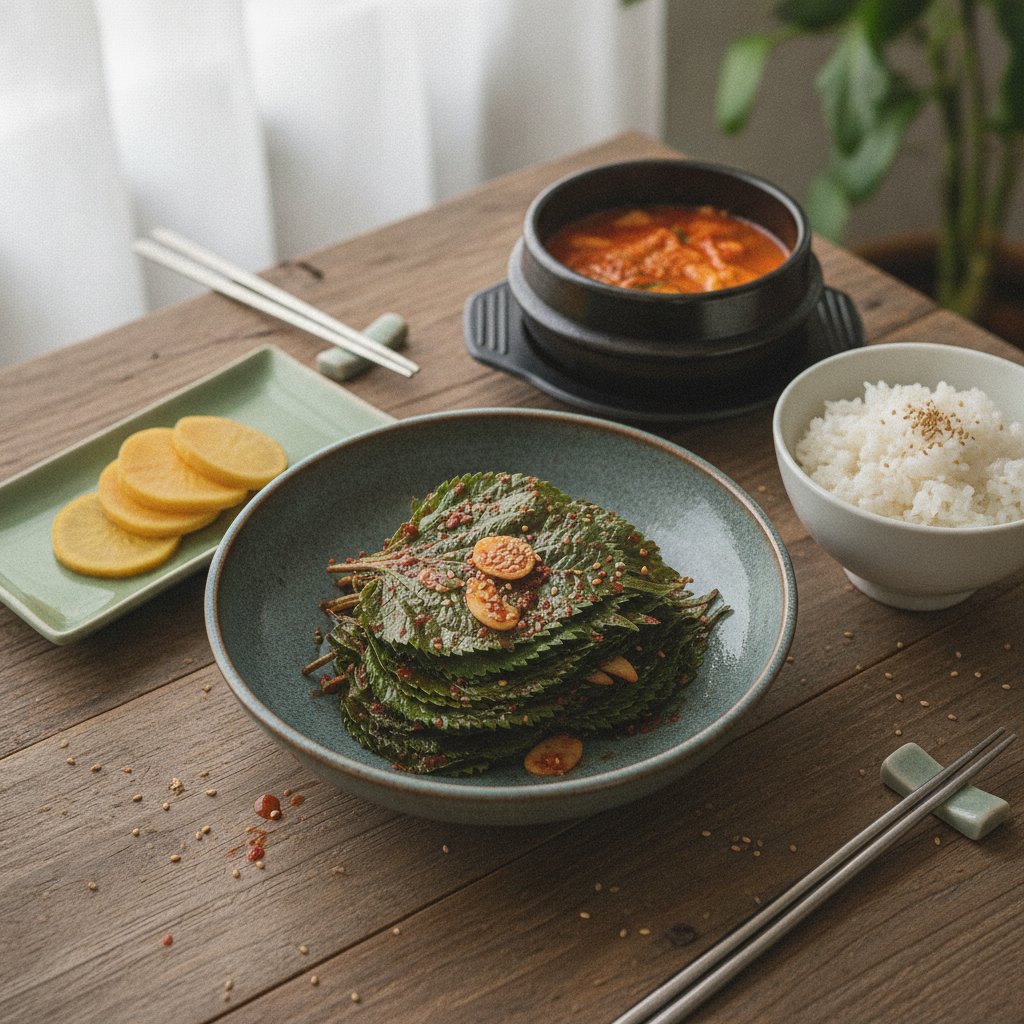
Kkaennip Kimchi (Quick Pickled Perilla Leaves)
This post contains affiliate links. As an Amazon Associate, we earn from qualifying purchases at no extra cost to you.
Every autumn in my Seoul neighborhood, my mother would buy stacks of fresh perilla leaves, their purple-tinged backs brimming with an earthy, anise-like aroma. She would layer them two by two in a wide glass container, spreading a fragrant garlic-chili marinade between each leaf like a deck of cards. By dinnertime, the crisp leaves would soften into kkaennip kimchi (perilla leaf kimchi), one of Korea’s most beloved winter prep side dishes.
Perilla leaf kimchi sits in a special category of Korean banchan (side dishes). Unlike cabbage tongbaechu kimchi (napa cabbage kimchi), which requires days of fermentation to develop its signature sour punch, perilla leaf kimchi is a quick-pickled preparation. You can eat it thirty minutes after making it, though it gets even better after sitting in the refrigerator for a day or two. The distinct herbal flavor of the leaves cuts through rich meat dishes like samgyeopsal (grilled pork belly) or jeyuk bokkeum (spicy pork stir-fry), but my favorite way to enjoy it is peeled off one leaf at a time and draped over a spoon of hot, steaming white rice.
For cooks living outside Korea, making this dish is surprisingly accessible. Fresh perilla leaves are becoming easier to find at Asian markets, and the seasoning base relies on staple Korean pantry items that you can easily order online or find at a local grocer. This version balances traditional Seoul-style flavors with simple, reliable techniques so your leaves stay tender, flavorful, and vibrant for weeks.
Why This Works
- Layering in pairs: Applying seasoning to every two leaves instead of every single leaf cuts prep time in half without sacrificing flavor distribution.
- Hydrated gochugaru paste: Mixing the chili flakes with soy sauce, fish sauce, and aromatics beforehand allows the pepper flakes to bloom, creating a sleek paste that sticks to the leaves rather than sliding off.
- Thinly sliced aromatic bed: Paper-thin onions and carrots release natural sugars as they sit, balancing the pungent herb without needing heavy amounts of refined sugar.
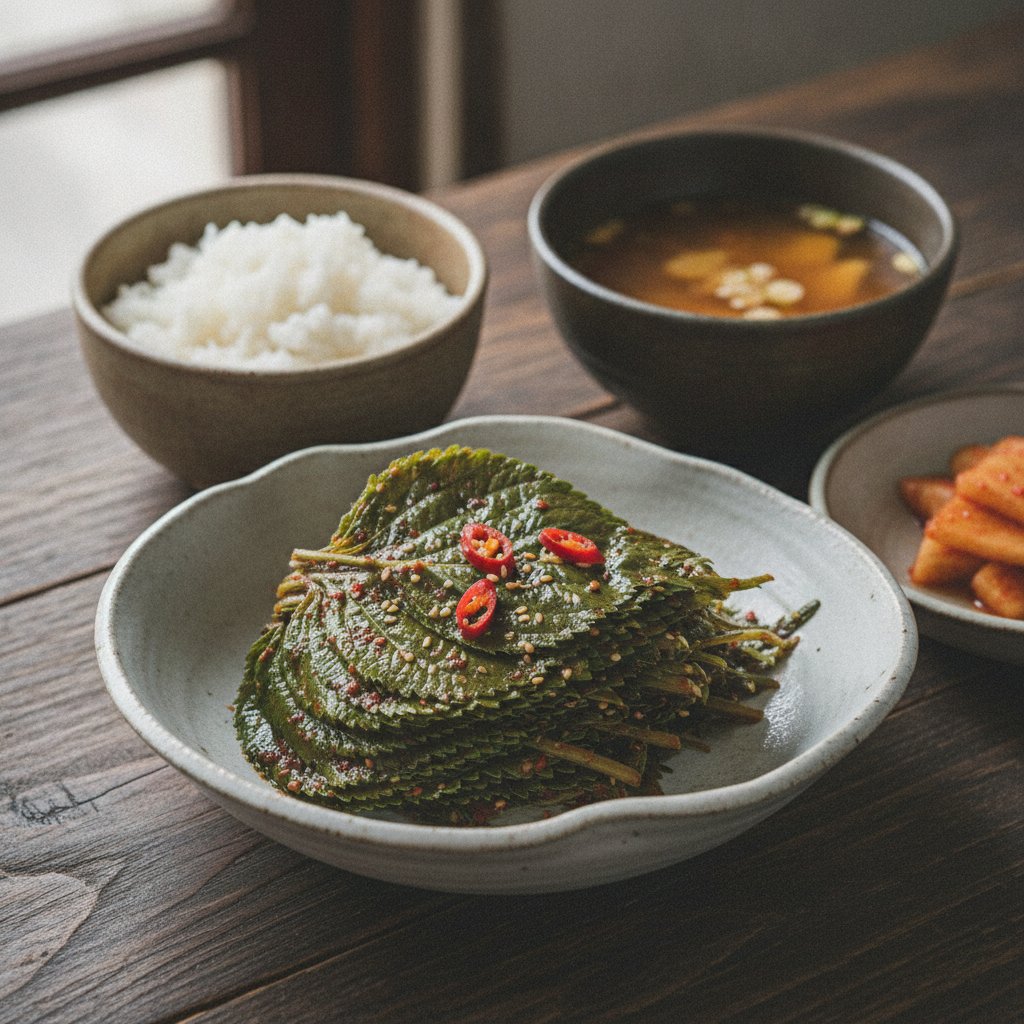
Ingredients
- 50 fresh perilla leaves (about 100 g / 3.5 oz)
- 4 tbsp soy sauce (60 ml)
- 2 tbsp fish sauce (30 ml), preferably Korean anchovy fish sauce
- 2 tbsp Korean chili flakes / gochugaru (15 g / 0.5 oz)
- 1 tbsp Korean plum extract / maesil-cheong (15 ml)
- 1 tbsp garlic, minced (4 cloves / 15 g)
- 1 tsp ginger, finely grated (5 g)
- 2 green onions, finely chopped (30 g / 1 oz)
- 1/2 medium carrot, julienned paper-thin (50 g / 1.7 oz)
- 1/2 small yellow onion, sliced paper-thin (50 g / 1.7 oz)
- 1 tbsp toasted sesame seeds (10 g)
- 1 tbsp toasted sesame oil (15 ml)
Substitutions
If you cannot source Korean perilla leaves, Japanese shiso leaves can work, though shiso has a slightly more floral, citrus-heavy aroma compared to the earthy, minty note of Korean perilla. For the Korean plum extract, you can substitute 1 tablespoon of raw honey or rice syrup mixed with 1/2 teaspoon of apple cider vinegar to replicate that sweet-and-sour complexity. If fish sauce is unavailable, use additional soy sauce or a dash of liquid aminos along with a splash of vegan fish sauce to maintain the essential umami base.
🛒 Kkaennip Kimchi
As an Amazon Associate we earn from qualifying purchases.
Shop Ingredients & Tools →How to Make It
- Wash and dry the perilla leaves thoroughly: Submerge the leaves in a large bowl of cool water and gently agitate to loosen any dirt. Rinse each leaf under running water, then stack them gently. Shake off excess moisture and pat each leaf completely dry with clean kitchen towels. Why: Excess water left on the leaves dilutes the savory marinade and causes the kimchi to spoil much faster in the refrigerator.
- Trim the stems: Use kitchen shears to cut the stems down, leaving about 1/2 inch (1.2 cm) attached to each leaf. Why: Keeping a short bit of stem acts as a convenient handle when pulling individual leaves apart with your chopsticks at the dinner table.
- Prepare the aromatic vegetable mix: Julienne the carrot and slice the yellow onion as thinly as possible, ideally using a mandoline slider. Chop the green onions finely. Why: Thinly cut vegetables soften quickly under the salt content of the sauce, allowing them to cling to the flat surfaces of the leaves without creating bulky air gaps.
- Bloom the chili paste: In a medium mixing bowl, combine the soy sauce, fish sauce, Korean plum extract, minced garlic, grated ginger, and gochugaru. Stir well and let the mixture sit for 10 minutes before adding the chopped green onions, carrot, yellow onion, sesame seeds, and toasted sesame oil. Why: Allowing gochugaru to hydrate in the liquid ingredients before adding veggies fully releases its deep red color and prevents a gritty, dusty texture in the marinade.
- Stack and layer the leaves: Place a shallow glass container on your workspace. Lay two perilla leaves side-by-side or slightly overlapping at the bottom of the container. Spoon about 1/2 tablespoon of the seasoned mixture over the top leaf, using the back of the spoon to smear it thinly across the surface. Lay another pair of leaves on top, rotating their orientation so the stack stays level, and repeat the sauce layering until all leaves are used. Why: Stacking in pairs saves time while ensuring osmotic pressure pushes the marinade evenly into every leaf without over-salting them.
- Rest and press: Gently press down on the completed stack with clean hands or the back of a spoon to compact the leaves and draw out their natural juices. Cover tightly with a lid and let the container sit on the counter at room temperature for 1 to 2 hours before transferring to the fridge. Why: A short ambient rest activates osmotic exchange, allowing the salt and umami to penetrate the tough leaf fibers before cold storage slows the process down.
Tips from a Korean Kitchen
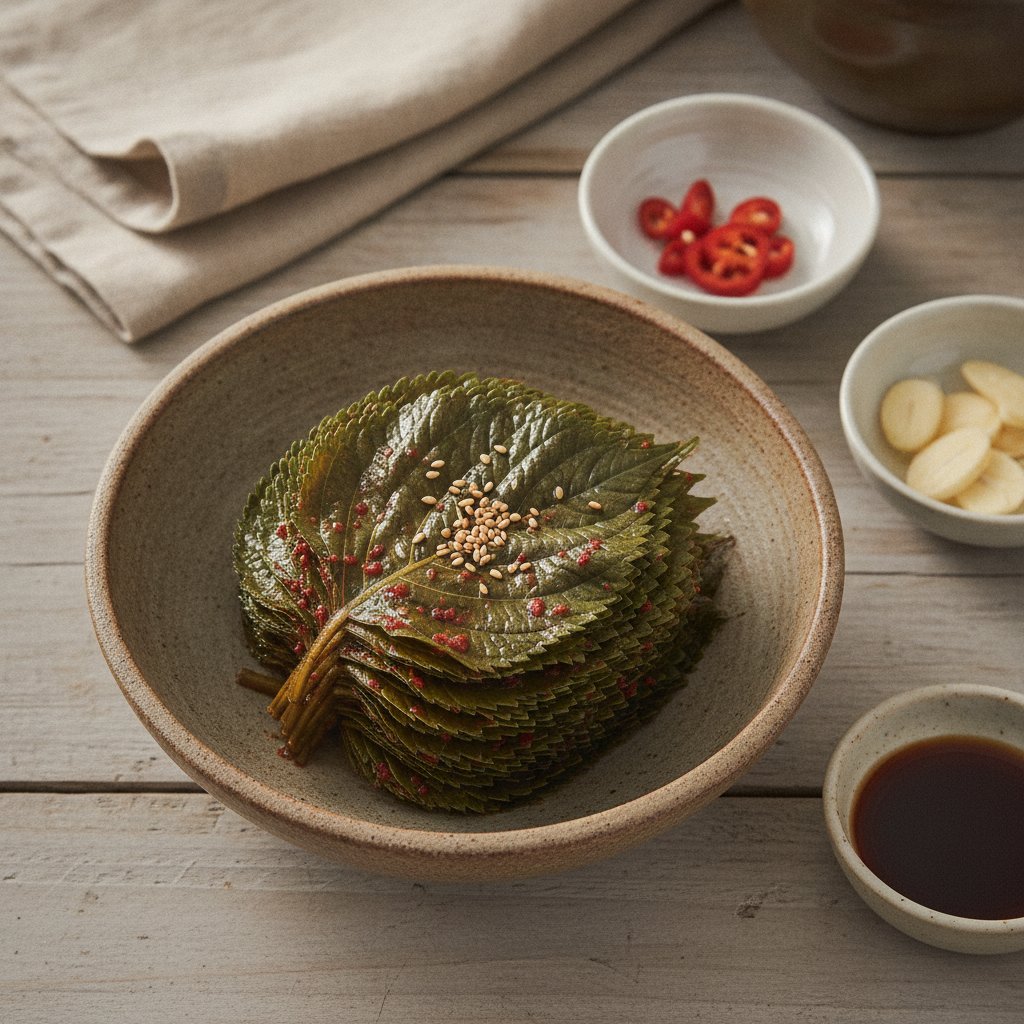
In Korean homes, the most common mistake when making perilla leaf kimchi is over-saucing. Because perilla leaves are thin and delicate, they do not require a heavy coating like cabbage does. A light, patchy smear of seasoning per pair of leaves is more than enough; as the salt draws out moisture, the liquid creates its own brine inside the container and coats every leaf naturally within 24 hours.
Another useful habit is alternating stem directions as you build your stack. If you put all the thick leaf bases on one side, your stack will slant precariously and marinades will pool unevenly at one end of the container. By rotating the stems 180 degrees with every layer, the stack stays completely flat, guaranteeing uniform pickling.
Lastly, pay attention to container size. Choose a container where the leaves fit snugly without curling wildly up the edges. A flat glass storage container works far better than a deep, narrow jar because it keeps the leaves flat, making serving much easier later on.
Storage
Store your perilla leaf kimchi in a clean, airtight glass container in the coldest part of your refrigerator. Stainless steel or glass containers are ideal because perilla leaves and gochugaru will permanently stain white plastic containers. This dish does not require cooking or reheating; simply serve it chilled straight from the fridge.
It is ready to eat within a couple of hours, but peaks in flavor between days 2 and 7, when the herbal bite of the leaf mellows out into the garlic-soy brine. Kept properly, perilla leaf kimchi remains delicious for 3 to 4 weeks in the refrigerator. Freezing is not recommended, as freezing destroys the delicate cellular structure of the leaves, turning them mushy upon thawing.
🛒 Kkaennip Kimchi
As an Amazon Associate we earn from qualifying purchases.
Shop Ingredients & Tools →FAQ
Can I use Japanese shiso leaves instead of Korean perilla leaves?
Yes, you can use green shiso leaves if Korean perilla leaves are unavailable. However, shiso belongs to a slightly different plant family with a distinct floral and citrus note. The dish will still be delicious, but it will taste brighter and less earthy than traditional Korean perilla leaf kimchi.
Is perilla leaf kimchi fermented like cabbage kimchi?
Perilla leaf kimchi is considered a quick-pickled geotjeori style dish rather than a heavily fermented kimchi. While slight natural fermentation occurs over weeks in the fridge, it is intended to be enjoyed fresh for its fragrant herb flavor rather than its sour, aged notes.
How do you eat perilla leaf kimchi at the table?
Place the container or a small pile of leaves on the table. Use your chopsticks to grab a single stem, peel one leaf away from the stack, drape it over a spoonful of warm white rice, and fold the leaf around the rice before taking a bite.
More Korean Recipes
- Crunchy & Refreshing Kkakdugi Recipe (Cubed Radish Kimchi)
- Kimchi Storage (김치 보관법) & Sour Kimchi Tips
- Quick Oi Muchim (Cucumber Kimchi) in 15 Minutes
- How to Make Kimchi (김치) at Home: A Small-Batch Beginner’s Guide
🛒 Kkaennip Kimchi
As an Amazon Associate we earn from qualifying purchases.
Shop Ingredients & Tools →