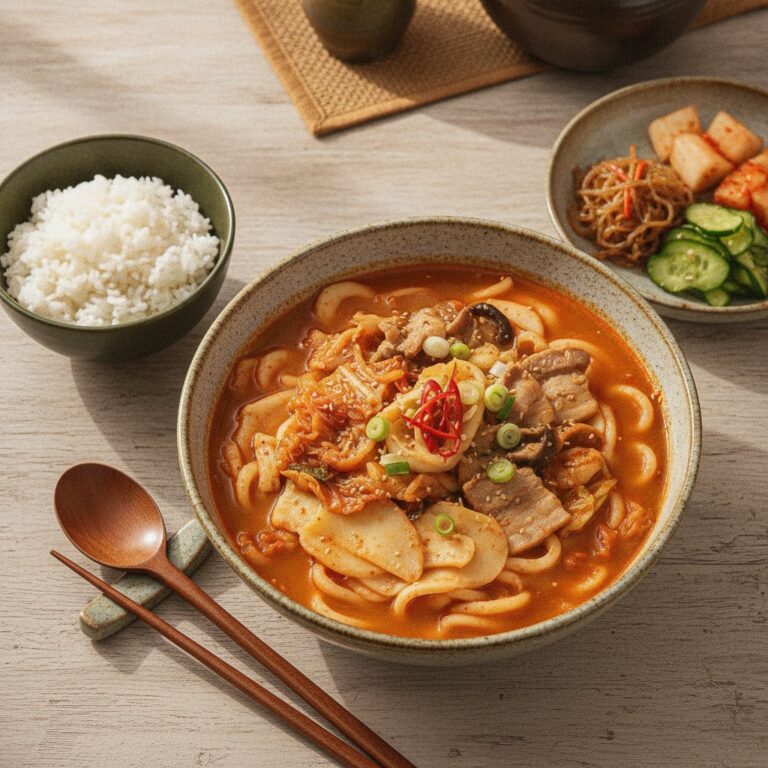
Dakhanmari Recipe: Mild Korean Whole Chicken Soup
This post contains affiliate links. As an Amazon Associate, we earn from qualifying purchases at no extra cost to you.
At a glance
- In shortLearn how to make Korean dakhanmari, a mild chicken soup served with dipping sauce and noodles.
- Best forHome cooks seeking an easy Korean comfort food recipe
- DifficultyEasy
- HeatMild
- Key pointsParboiling the chicken cleans impurities to create a clear, clean broth. · Simmering gently keeps the chicken tender and prevents cloudy broth. · Custom choganjang dipping sauce lets diners adjust heat and tanginess.
- Heads-upViolent boiling breaks up chicken pieces and emulsifies fat, making broth cloudy.
On a cold night in Dongdaemun, Seoul, narrow alleys glow under red neon signs and smell intensely of rich chicken broth, garlic, and fresh green onions. Stepping into one of these bustling diners, you are immediately handed a massive stainless steel basin sitting atop a tabletop burner. Inside floats a whole, freshly quartered chicken simmered in clear broth alongside thick chunks of radish, tender potatoes, and chewy rice cakes. This is dakhanmari (Korean mild whole chicken soup), a staple of Korean comfort food culture that translates literally to “a whole chicken.”
Unlike samgyetang (ginseng chicken soup), which relies on medicinal roots and stuffed glutinous rice, dakhanmari (Korean mild whole chicken soup) is delightfully simple and completely customizable. What makes this dish legendary across Korea isn’t an overly complicated spice blend, but rather its communal, interactive nature. You slice the chicken at the table, sip the mild, deeply comforting broth, and dip each juicy morsel into a custom, tangy-spicy mustard sauce you mix yourself. When the meat and vegetables are gone, you toss fresh kalguksu (hand-cut wheat noodles) directly into the leftover broth for a satisfying final course.
In my home in Seoul, this is the meal we gather around whenever someone feels a autumn chill coming on or when we want a cozy weekend dinner with friends. The beauty of this recipe is that it requires basic ingredients you can buy at any Western supermarket, yet delivers the exact taste of Seoul’s famous chicken alley.
Why This Works
- Blanching the chicken first purges residual blood and impurities, yielding a crystal-clear, clean broth without any Gam-mi (gamey smell) or cloudy foam.
- Building an aromatic base with whole garlic cloves and green onion roots extracts deep savory flavor during a short simmer, giving you hours-long flavor in under 45 minutes.
- A balance of sweet chicken broth and sharp choganjang (spicy vinegar-mustard dipping sauce) keeps every bite fresh and prevents the rich poultry fat from feeling heavy.

Ingredients
- 1 whole chicken, approximately 1.2 kg to 1.4 kg (2.6 to 3 lbs), cut into small, bone-in pieces
- 2.5 liters (approx. 10.5 cups) water
- 300 g (about 10 oz) Korean radish (mu) or Daikon radish, peeled and cut into 1/2-inch thick half-moons
- 2 large stalks Korean green onion (daepa) or 1 large leek (white and light green parts only), cut into 2-inch pieces
- 15 to 20 whole garlic cloves (about 60 g / 2 oz), lightly smashed
- 15 g (0.5 oz / 1 thumb-sized knob) fresh ginger, sliced into thin coins
- 300 g (about 10 oz / 2 medium) Yukon Gold potatoes, peeled and sliced into 3/4-inch thick rounds
- 150 g (about 5.3 oz / 1 cup) Korean rice cakes (tteokbokki tteok)
- 200 g (about 7 oz) Napa cabbage or green cabbage, cut into bite-sized squares (optional)
- 1 tsp fine sea salt (adjust to taste)
For the Signature Dipping Sauce (Choganjang):
- 60 ml (1/4 cup) soy sauce
- 45 ml (3 tbsp) white vinegar or apple cider vinegar
- 30 ml (2 tbsp) chicken broth (taken directly from the pot while cooking)
- 15 g (1 tbsp) granulated sugar
- 15 g (1 tbsp) Korean coarse chili flakes (gochugaru)
- 10 g (2 tsp) yellow mustard paste or Dijon mustard
- 15 g (1 tbsp) finely minced fresh garlic
- 50 g (about 1.8 oz / 1 cup) garlic chives (buchu) or regular fresh chives, cut into 1-inch pieces
For the Noodle Finish:
- 200 g (about 7 oz) fresh or dried Korean hand-cut wheat noodles (kalguksu)
Substitutions
If you cannot source every Korean ingredient at your local supermarket, these easy swaps will keep your soup tasting authentic:
- Korean radish (mu): Daikon radish is the best substitute, available at most broad Western grocery stores. In a pinch, red radishes or turnips work, though turnips introduce a slightly earthier note.
- Korean green onion (daepa): Standard Western leeks are the closest match in sweetness and texture. Use the white and light green portions. If leeks are unavailable, use double the amount of regular spring onions.
- Korean chili flakes (gochugaru): Gochugaru provides a mild heat with a smoky sweetness. Substitute with unsmoked coarse red chili flakes mixed with a tiny pinch of sweet paprika. Avoid cayenne powder, as it is far too spicy and fine.
- Garlic chives (buchu): Standard garlic chives can be replaced with regular garden chives combined with a small handful of thinly sliced green onion tops.
- Korean rice cakes (tteokbokki tteok): If you cannot find Korean tubular rice cakes, feel free to omit them or substitute with extra potato slices or gnocchi.
🛒 Dakhanmari Recipe
As an Amazon Associate we earn from qualifying purchases.
Shop Ingredients & Tools →How to Make It
- Parboil the chicken to ensure a clean broth: Place the chicken pieces into a large stockpot and cover with cold water. Bring to a rapid boil over high heat and let it boil for 4 to 5 minutes. Scum and gray foam will rise to the surface. Drain the chicken completely into a colander and rinse each piece thoroughly under cold running water to wash away bone fragments and coagulated protein. Scrub the pot clean. Why: Parboiling cooks off the impurities that cause cloudy, bitter broth, guaranteeing a clear and bright soup base.
- Build the aromatic broth: Return the clean chicken to the pot. Add 2.5 liters of fresh water, the radish slices, green onion chunks, smashed garlic cloves, and sliced ginger. Bring the pot to a boil over high heat. Why: Adding aromatics from the very beginning allows their natural sugars and essential oils to meld with the chicken fat as it renders.
- Simmer gently over medium heat: Once boiling, reduce the heat to medium-low, cover with a lid, and let it simmer gently for 20 minutes. Maintain a soft bubble rather than a rolling boil. Why: Violent boiling breaks up the chicken pieces and emulsifies fat into the water, making the broth cloudy and meat tough. A gentle simmer keeps the chicken tender and juicy.
- Prepare the custom dipping sauce base: While the broth simmers, prepare individual sauce bowls for each diner. In a medium bowl, whisk together the soy sauce, vinegar, 2 tablespoons of warm broth skimmed from the pot, sugar, gochugaru, mustard paste, and minced garlic until the sugar dissolves. Divide this base into small shallow bowls and top generously with fresh sliced chives. Why: Mixing the sauce fresh allows each person at the table to adjust the ratio of mustard, vinegar, or chili flakes to suit their personal heat tolerance.
- Add potatoes, cabbage, and rice cakes: Add the sliced potatoes to the simmering pot. Cover and cook for 10 minutes until the potatoes begin to soften. Next, stir in the cabbage (if using) and Korean rice cakes. Season the broth with 1 teaspoon of sea salt. Simmer uncovered for another 5 to 7 minutes, or until the rice cakes are soft and chewy and the potatoes can be easily pierced with a chopstick. Why: Potatoes take longer to cook than rice cakes; staging their entry prevents the rice cakes from becoming mushy and disintegrating into the broth.
- Serve and enjoy the meat and vegetables: Place the steaming pot on a trivet in the center of the table (or on a portable burner set to low). Serve the chicken, tender potatoes, radish, and chewy rice cakes into small bowls. Dip each piece of chicken and vegetable directly into your personal spicy choganjang sauce before eating. Ladle clear, seasoned broth into separate small cups to sip alongside.
- Finish with the noodle course (Kalguksu): Once most of the chicken and vegetables have been eaten, skim out any remaining large bones or stray aromatics. Turn the heat under the remaining broth up to high. Add the kalguksu noodles directly into the boiling, starch-rich broth. Cook for 4 to 5 minutes, stirring occasionally so the noodles do not stick to the bottom, until they are slippery and cooked through. Serve hot. Why: The starch from the potatoes and noodles lightly thickens the rich chicken broth at the very end, creating a luscious, comforting noodle soup to close out the meal.

Tips from a Korean Kitchen
- Smashed garlic, not minced, for the broth: When preparing garlic for the soup pot, gently crush the cloves with the flat side of your knife rather than mincing them. Finely minced garlic melts into floating particles that make the broth murky, whereas smashed cloves release pure garlic aroma while staying intact.
- Adjust the dipping sauce at the table: Korean diners famous for dakhanmari always leave pots of raw gochugaru paste, prepared yellow mustard, and vinegar on the table. Encourage your family or guests to taste their sauce base and add extra mustard for sharp heat, or more vinegar for brightness.
- Control your soup’s salt level: The broth itself is intentionally kept lightly salted (around 1 teaspoon of salt for the whole pot) because the chicken is meant to be dipped in the seasoned soy-vinegar sauce. Do not over-salt the broth early on, or the combination with the dipping sauce will become overly salty.
- Rinse dried or fresh noodles before adding: If your kalguksu noodles have a heavy coating of loose flour on the outside, briefly rinse them under cold tap water just before dropping them into the pot. This prevents the final broth from becoming pasty or gummy.
Storage
Refrigeration: Allow leftover soup and chicken to cool to room temperature. Transfer to an airtight container and store in the refrigerator for up to 3 to 4 days. Keep any remaining dipping sauce in a separate sealed jar in the fridge for up to 1 week.
Freezing: You can freeze the broth and cooked chicken for up to 2 months. However, remove cooked potatoes, rice cakes, and noodles before freezing, as their textures degrade upon thawing, becoming grainy and waterlogged. Freeze the broth and meat in a sealed freezer-safe container. When ready to eat, thaw overnight in the fridge, bring to a boil, and add fresh potatoes and rice cakes.
Reheating: Warm leftovers in a saucepan over medium heat until steaming hot throughout (about 8-10 minutes). If reheating broth that already contains rice cakes, add a splash of extra water, as the starch will have absorbed broth overnight.
🛒 Dakhanmari Recipe
As an Amazon Associate we earn from qualifying purchases.
Shop Ingredients & Tools →FAQ
What is the difference between dakhanmari and samgyetang?
While both are famous Korean chicken soups made with whole chickens, samgyetang (ginseng chicken soup) uses small young chickens stuffed with glutinous rice, ginseng, jujubes, and garlic, simmered into an earthy, herbal broth eaten primarily during summer. Dakhanmari (Korean mild whole chicken soup) uses regular cooking chicken, features a clean garlic-radish broth, includes rice cakes and potatoes, and relies heavily on a tangy, spicy mustard dipping sauce mixed individually at the table.
earnings
Can I make dakhanmari using boneless chicken thighs or breasts?
Bone-in, skin-on chicken is traditional and highly recommended because chicken bones and collagen give the clear broth its silky body and natural savory richness. However, if you prefer boneless meat, use bone-in chicken thighs or a mix of boneless thighs with extra chicken stock substituted for half of the water to ensure the broth stays flavorful.
Why is my dipping sauce too sharp or spicy?
The sharpness comes from yellow mustard and raw garlic, while the heat comes from gochugaru. If your choganjang tastes too intense, balance it by whisking in an extra tablespoon of warm chicken broth and a pinch of sugar. The warm chicken fat in the broth immediately tempers the raw bite of the mustard and garlic.
More on Soups, Stews & Braises
- Easy Mandutguk (Korean Dumpling Soup)Learn how to make traditional Korean dumpling soup with a quick kelp and anchovy broth.
- Korean Spicy Braised Flounder (Gajami Jorim)Learn how to make Gajami Jorim, a comforting Korean spicy braised flounder with radish.
- Korean Garlic Boiled Whole Chicken (Dak Baeksuk)Learn how to make classic Korean garlic boiled chicken stuffed with sweet glutinous rice in a rich, simple broth.
See every Soups, Stews & Braises post in our Main Dishes guide.
Handy toolsRecipe scaler · Measurement converter · Korean pantry guide · Recipe Finder
🛒 Dakhanmari Recipe
As an Amazon Associate we earn from qualifying purchases.
Shop Ingredients & Tools →More Korean Recipes
- Bulgogi Jeongol Recipe: Korean Beef Hot Pot at Home
- Dak Kalguksu Recipe: Easy Korean Chicken Noodle Soup
- Spicy Korean Cold Noodles: Bibim Naengmyeon Recipe
- Kimchi Jeon & Pajeon: One Batter, Two Korean Pancakes
🛒 Dakhanmari Recipe
As an Amazon Associate we earn from qualifying purchases.
Shop Ingredients & Tools →