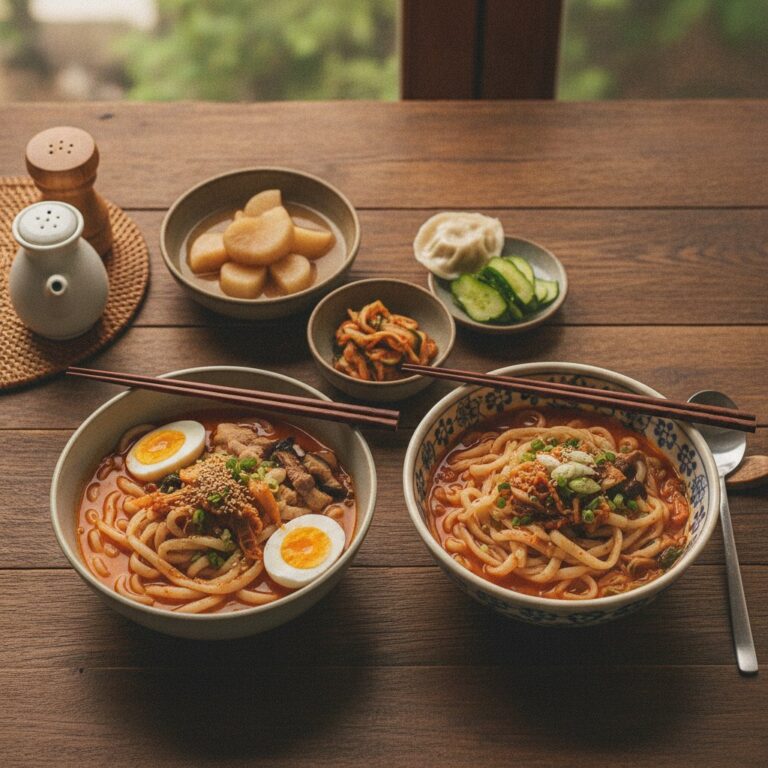
Rich Perilla Seed Noodle Soup (Deul Kkae Kalguksu)
This post contains affiliate links. As an Amazon Associate, we earn from qualifying purchases at no extra cost to you.
At a glance
- In shortHow to make rich Korean perilla seed noodle soup with a creamy, dairy-free broth.
- Best forHome cooks wanting a non-spicy Korean noodle soup
- DifficultyEasy
- HeatNot spicy
- Key pointsWhisk perilla powder with flour and water before adding to avoid clumping. · Use hulled perilla seed powder to ensure a smooth, silky soup base. · Serve immediately so the noodles do not absorb all the broth.
- Heads-upDo not boil violently after adding perilla slurry or the fats may separate.
Rainy autumn afternoons in Seoul always call for a bowl of piping hot soup that coats your spoon like velvet. Growing up, whenever monsoon rain tapped on our kitchen window, my grandmother didn’t reach for spicy kimchi stew—she pulled out a glass jar of toasted perilla seed powder from the back of the freezer. Within twenty minutes, the entire apartment would fill with an earthy, nutty aroma that felt like a warm wool blanket.
That dish was deul-kkae kalguksu (perilla seed noodle soup), a traditional Korean noodle soup made with bouncy knife-cut wheat noodles swimming in a milky, savory broth thickened with ground toasted perilla seeds. Unlike spicy red Korean soups powered by gochujang (chili paste) or gochugaru (chili flakes), this soup relies on subtle savory depth, natural starches, and the unforgettable aroma of perilla. In Korea, people flock to specialty noodle shops in the cool autumn and winter months to order this dish, usually served alongside a crock of fresh, crisp geotjeori (freshly made unfermented kimchi).
If you have never tried perilla seed soup before, the texture might surprise you. It sits somewhere between a delicate noodle broth and a rich Western cream soup, yet it uses no dairy whatsoever. The secret lies in how the ground perilla seeds interact with the starchy broth from the handmade noodles. This home recipe brings that exact Seoul noodle shop experience straight to your home kitchen using accessible ingredients and straightforward techniques.
Why This Works
- Slurring perilla powder with starch: Whisking toasted perilla seed powder with a touch of rice flour before adding it to hot stock prevents clumping and creates a silky, velvety broth without heavy cream.
- Direct noodle cooking: Cooking fresh knife-cut noodles directly in the simmering broth allows loose surface flour to naturally thicken the soup to its signature comforting texture.
- Dual umami base: Combining a light anchovy-kelp stock with nutty perilla seeds creates a complex layer of savoriness that lifts the entire dish.

Ingredients
- 1200 ml (about 5 cups) cold water
- 15 g (about 0.5 oz / 10 to 12 large) dried soup anchovies (gukmul-yong myeolchi), heads and guts removed
- 1 piece (10×10 cm / 4×4 inches) dried kelp (dashima)
- 60 g (about 3/4 cup) toasted hulled perilla seed powder (geopi deul-kkae-garu)
- 2 tbsp (20 g) glutinous rice flour or all-purpose flour
- 300 g (about 10.5 oz) fresh Korean knife-cut noodles (kalguksu)
- 150 g (about 1.5 cups) Korean zucchini or regular zucchini, cut into thick matchsticks
- 100 g (about 1 cup) king oyster mushroom or shiitake mushrooms, thinly sliced
- 100 g (about 1 cup) potato, peeled and cut into 1/4-inch thin half-moons
- 1.5 tbsp (22 ml) Korean soup soy sauce (guk-ganjang)
- 1 tsp (5 g) minced garlic
- 0.5 tsp fine sea salt, adjusted to taste
- 1 green onion, thinly sliced for garnish
Substitutions
Finding exact Korean pantry items outside East Asia can sometimes take a bit of hunting, but you can easily adapt this soup using items from your local supermarket:
- Toasted Perilla Seed Powder (Deul-kkae-garu): This is the defining flavor of the dish. Look for packages labeled “hulled toasted perilla powder” at Asian groceries or online retailers like Amazon. In a absolute pinch, toasted white sesame seeds ground into a fine meal can offer a similar nutty body, though the distinct herbal perilla aroma will differ.
- Anchovy-Kelp Stock: If dried anchovies and kelp are unavailable, substitute with 1200 ml (5 cups) of mild vegetable broth or water boiled with a tablespoon of light soy sauce and a pinch of dried mushroom powder.
- Korean Soup Soy Sauce (Guk-ganjang): Soup soy sauce is saltier and lighter in color than regular soy sauce. If using standard dark soy sauce, use 1 tablespoon of regular soy sauce mixed with 0.5 teaspoon of fine salt so you don’t darken the light cream color of the broth.
- Fresh Kalguksu Noodles: Fresh knife-cut noodles are sold in the refrigerated section of Asian markets (often from brands like CJ or Pulmuone). If unavailable, use fresh broad udon, fresh fettuccine pasta, or dried flat wheat noodles cooked according to package instructions.
🛒 Rich Perilla Seed Noodle Soup
As an Amazon Associate we earn from qualifying purchases.
Shop Ingredients & Tools →How to Make It
- Build the umami stock base: Place 1200 ml (5 cups) of cold water, gutted dried anchovies, and dried kelp into a medium pot. Bring to a boil over medium-high heat. As soon as the water boils, remove the kelp with tongs and discard it. Lower the heat to medium and let the anchovies simmer gently for 12 to 15 minutes. Strain out the anchovies and retain the clear broth. Why: Kelp releases bitter mucilage if boiled too long, whereas anchovies require at least 15 minutes of gentle heat to extract full flavor without fishiness.
- Prepare the vegetables and starch slurry: While the stock simmers, cut your potato, zucchini, and mushrooms into uniform thick slices. In a small bowl, whisk together 60 g (3/4 cup) toasted perilla seed powder, 2 tablespoons rice flour, and 120 ml (1/2 cup) of lukewarm water or warm broth until smooth. Why: Adding perilla seed powder and flour directly into boiling hot soup will cause fine powder to clump together into gritty floating balls. Pre-mixing ensures a silky broth.
- Par-cook the dense vegetables: Return the strained anchovy stock to the pot and bring it back to a boil. Add the sliced potato and minced garlic. Simmer over medium heat for 4 minutes until the potato edges begin to soften slightly. Why: Dense root vegetables like potatoes cook slower than fresh noodles and zucchini. Pre-cooking prevents crunchy potatoes in fully cooked noodles.
- Prep and cook the noodles: Take your fresh kalguksu noodles out of the package and gently shake off excessive loose starch flour over a sink. Drop the noodles, zucchini, and mushrooms directly into the bubbling potato broth. Stir gently with chopsticks to prevent noodles from sticking together. Why: Excessive dusting flour turns broth into sludge, but keeping a light coating helps thicken the soup naturally into a comforting consistency.
- Incorporate perilla mixture and season: After the noodles cook for 3 minutes, lower the heat to medium-low and pour in the perilla slurry, stirring continuously. Add 1.5 tablespoons Korean soup soy sauce. Simmer gently for another 2 to 3 minutes until the broth thickens, turns milky, and the noodles are chewy and translucent. Why: Adding perilla powder toward the end preserves its delicate nutty aroma, which degrades under long, violent boiling.
- Adjust seasoning and serve: Taste the broth. Add up to 0.5 teaspoon fine sea salt if needed. Turn off heat, scatter sliced green onions over the top, and ladle immediately into wide bowls. Why: Wheat noodles continue to absorb broth rapidly once cooked, so serving right away keeps the noodles bouncy and prevents soup loss.

Tips from a Korean Kitchen
- Choose hulled perilla powder: Perilla powder comes in two varieties: unhulled (dark brown with speckled hulls) and hulled (cream-colored, fine texture). For soup, always choose geopi deul-kkae-garu (hulled). Unhulled powder is gritty and usually reserved for meat stews like gamjatang (pork bone stew).
- Watch the heat after adding perilla: Once you stir in the perilla slurry, do not let the pot boil rapidly on high heat. Perilla fats can separate if violently boiled, turning a creamy soup oily. Keep it at a steady gentle simmer.
- Dust off excess starch: Store-bought fresh noodles are heavily coated in starch to prevent sticking in packages. Give them a quick shake or light rinse under cold water right before dropping them into the broth if you prefer a lighter soup base.
- Serve with fresh kimchi: The creamy richness of perilla seed broth pairs best with sharp, crunchy foods. A quick cabbage salad or fresh unfermented kimchi cuts through the richness beautifully.
Storage
Perilla seed noodle soup is best eaten immediately after cooking. As fresh wheat noodles sit in hot broth, they absorb liquid rapidly, turning soft and making the soup overly thick.
If you plan to have leftovers, cook the noodles separately in boiling water, drain them, and place individual portions in bowls. Ladle the hot perilla broth over the cooked noodles when serving. Store leftover perilla broth in an airtight glass container in the refrigerator for up to 3 days. Reheat broth gently on the stove over medium-low heat, stirring occasionally to prevent sticking, and pour over freshly boiled noodles.
🛒 Rich Perilla Seed Noodle Soup
As an Amazon Associate we earn from qualifying purchases.
Shop Ingredients & Tools →FAQ
Is perilla seed powder the same as ground sesame seeds?
No, they come from entirely different plants. Perilla seeds come from Perilla frutescens (mint family) and have an earthy, herbal, nutty taste. Sesame seeds come from Sesamum indicum and taste sharper and sweeter. While sesame seeds can substitute in a pinch, the flavor profile will be noticeably different.
Can I make this recipe vegetarian or vegan?
Yes. Simply skip the dried anchovies and make a robust vegetable stock using dried kelp (dashima), dried shiitake mushrooms, and sliced daikon radish. Boil for 15 minutes, strain, and proceed with the rest of the recipe as written.
Where should I store perilla seed powder after opening?
Because perilla seeds contain high levels of healthy delicate oils, perilla powder oxidizes and turns rancid quickly at room temperature. Always store your toasted perilla seed powder in an airtight container or sealable freezer bag in the freezer. It stays fresh in the freezer for up to a year.
More on Porridges & Noodle Soups
- Korean Sweet Red Bean Porridge (Patjuk)A step-by-step recipe for making traditional Korean sweet red bean porridge with chewy rice cake balls.
- Sogogi Beosot Juk: Beef Mushroom PorridgeA guide to making comforting, savory Korean beef and shiitake mushroom rice porridge at home.
- Home-Style Sujebi RecipeLearn how to make rustic Korean hand-torn noodle soup from scratch with a savory anchovy broth.
See every Porridges & Noodle Soups post in our Soups & Stews guide.
Handy toolsRecipe scaler · Measurement converter · Korean pantry guide · Recipe Finder
🛒 Rich Perilla Seed Noodle Soup
As an Amazon Associate we earn from qualifying purchases.
Shop Ingredients & Tools →More Korean Recipes
- Clear Korean Clam Soup: Easy Jogae Tang Recipe
- Dak Hanmori Recipe: Korean Whole Chicken Hot Pot
- Kimchi Kongnamul Guk (Spicy Korean Bean Sprout Soup)
- Jeonbok Juk Recipe (Korean Abalone Porridge)
🛒 Rich Perilla Seed Noodle Soup
As an Amazon Associate we earn from qualifying purchases.
Shop Ingredients & Tools →