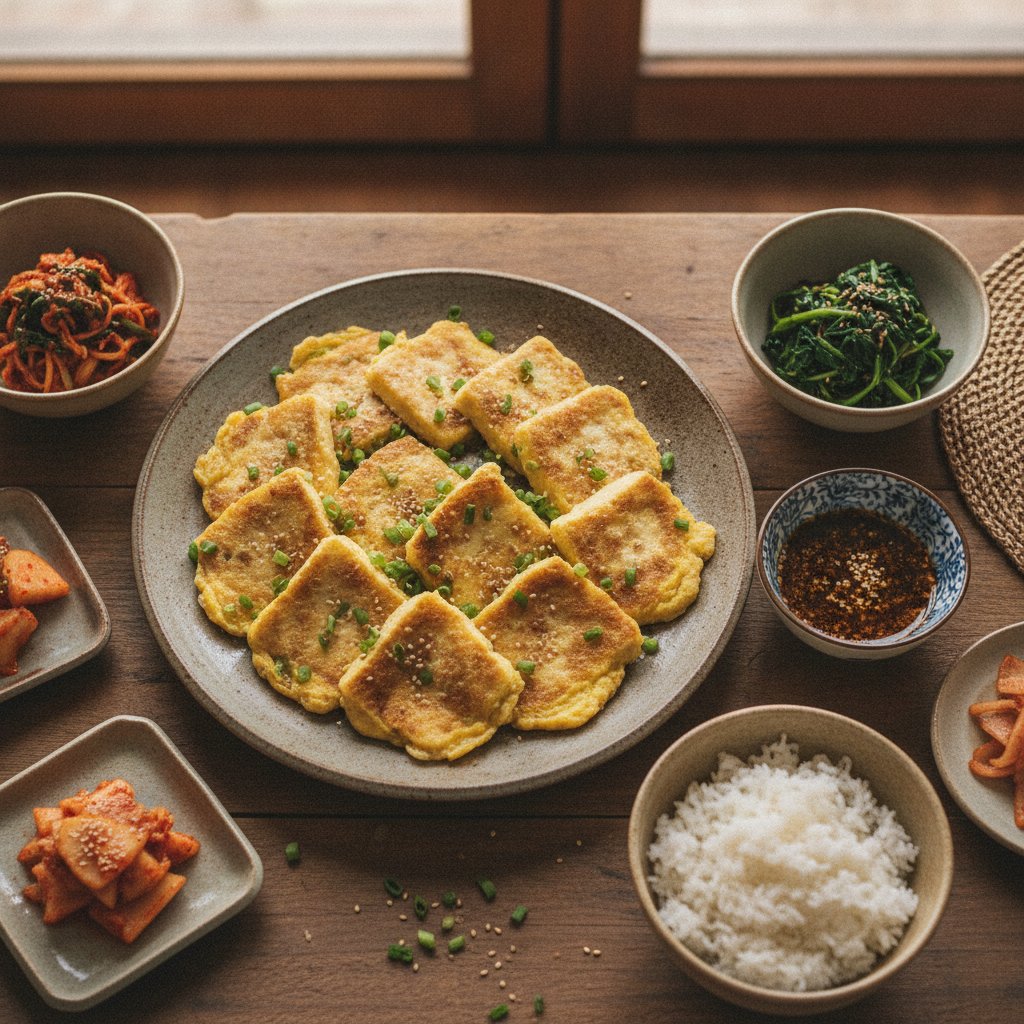
Korean Pan Fried Tofu with Egg (Dubu Jeon)
This post contains affiliate links. As an Amazon Associate, we earn from qualifying purchases at no extra cost to you.
Prep: 15 min · Cook: 10 min · Total: 25 min · Serves 4
On rainy weekday evenings in my Seoul kitchen, when the fridge looks nearly empty and I need dinner on the table in fifteen minutes, I always reach for a block of firm tofu and a couple of fresh eggs. My mother called dubu jeon (pan-fried tofu in egg batter) her ultimate back-pocket dish. It is warm, savory, comforting, and remarkably satisfying for something that relies entirely on humble pantry staples.
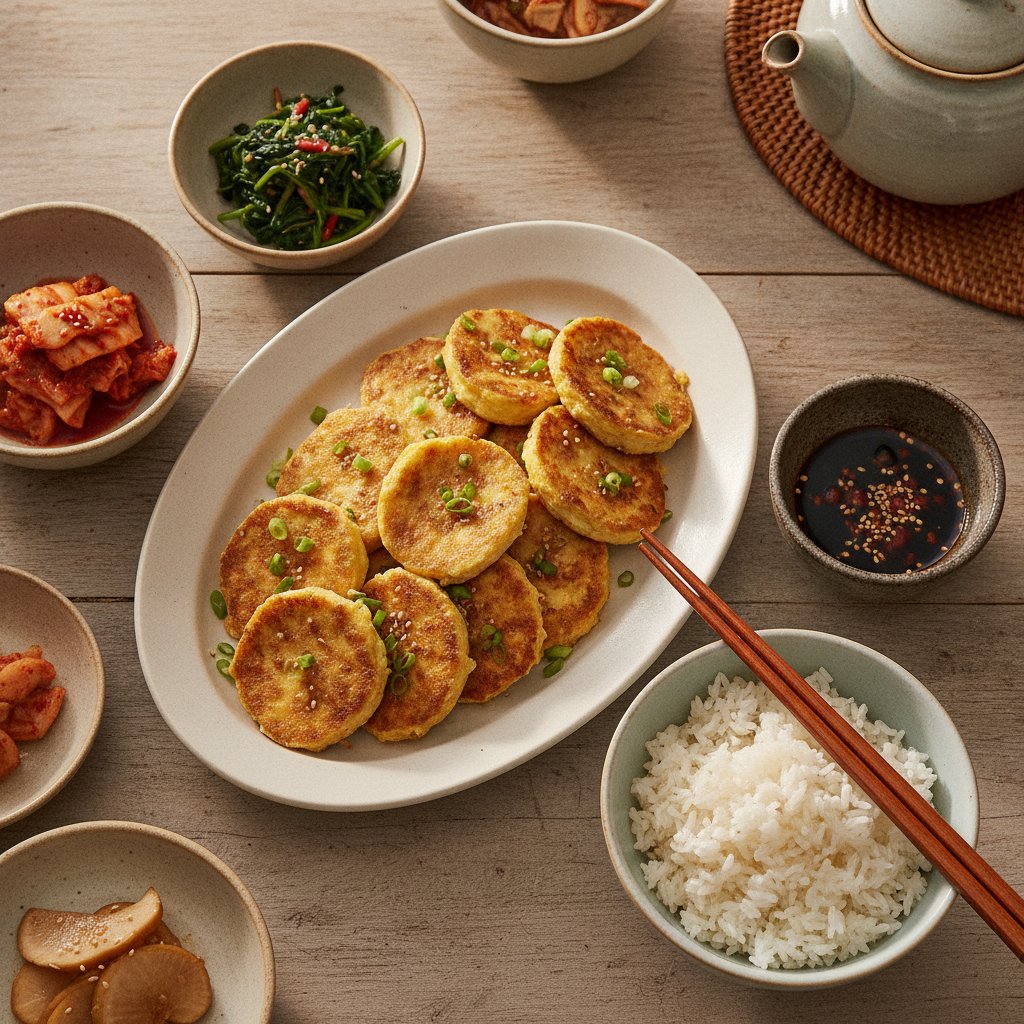
In Korea, dubu jeon (also frequently written as tubu jeon) is one of the most beloved daily banchan (side dishes). You will see it tucked into home-packed dosirak (lunchboxes), served on long metal trays in university cafeterias, and meticulously arranged on traditional brass plates during seollal (Lunar New Year) and chuseok (Harvest Festival) family feasts. While holiday versions might feature elaborate garnishes of crown daisy leaves or red chili threads, the home-style version I grew up eating is wonderfully straightforward: tender slabs of tofu, seasoned simply with salt, lightly dusted with flour, dipped in beaten egg laced with colorful green onions and carrots, and fried until golden brown.
If you have ever tried making pan-fried tofu at home and ended up with a bland, soggy interior or an egg batter that peeled off in the skillet, this recipe is designed to fix those exact problems. With just a few subtle shifts in technique—drawn from generations of Korean home cooking—you will turn humble tofu into a dish that even tofu skeptics asking for seconds.
Why This Works
- Salting first draws out surface moisture and seasons deeply: Tofu is mostly water. Pre-salting the sliced tofu draws out excess liquid through osmosis so it sears cleanly instead of steaming in the pan, while ensuring the tofu itself is seasoned to the core rather than bland under the egg coat.
- The thin starch bridge secures the egg batter: Wet tofu repels raw egg. Dusting the dried tofu slabs with a thin veil of flour or starch creates a dry, textured anchor that binds the egg batter permanently to the tofu surface during cooking.
- Gentle, controlled heat keeps the egg coat soft and golden: Frying over medium-low heat allows the interior of the tofu to warm through completely while cooking the egg batter into a tender, golden ribbon without scorching or puffing up with greasy air pockets.
Ingredients
- Tofu: 500 g (about 1.1 lbs or 1 standard block) extra-firm or firm tofu
- Fine sea salt: 3 g (about 1/2 tsp) for pre-seasoning the tofu
- All-purpose flour or potato starch: 30 g (about 1/4 cup) for dusting
- Eggs: 2 large eggs
- Green onion: 20 g (about 2 scallions), finely minced
- Carrot: 20 g (about 2 tbsp), finely minced for color and sweet contrast
- Neutral cooking oil: 30 ml (about 2 tbsp) canola, vegetable, or avocado oil for frying
- Soy sauce (for dipping sauce): 15 ml (1 tbsp) standard Korean or light soy sauce
- Rice vinegar (for dipping sauce): 10 ml (2 tsp)
- Water (for dipping sauce): 15 ml (1 tbsp) to mellow the saltiness
- Toasted sesame seeds (for dipping sauce): 2 g (1/2 tsp)
- Gochugaru (for dipping sauce, optional): 1 g (1/4 tsp) Korean chili flakes for a touch of heat
Substitutions
If you do not have extra-firm tofu, regular firm tofu works delightfully well; just give it an extra five minutes of resting time on paper towels to drain excess water. Avoid silken or soft tofu for this recipe, as it contains too much moisture and will crumble during dredging. For a gluten-free version, replace the all-purpose flour with potato starch, cornstarch, or rice flour—potato starch actually yields an exceptionally light, crisp coating that many Korean cooks prefer anyway. If you lack Korean rice vinegar, apple cider vinegar or plain white vinegar can be substituted in equal measure for the dipping sauce.
🛒 Korean Pan Fried Tofu with Egg
As an Amazon Associate we earn from qualifying purchases.
Shop Ingredients & Tools →How to Make It
- Slice and salt the tofu: Cut the block of tofu in half lengthwise, then slice it horizontally into rectangular slabs about 1.2 cm (1/2 inch) thick. Arrange the slabs in a single layer on a clean kitchen towel or a double layer of heavy-duty paper towels. Sprinkle 3 g (about 1/2 tsp) of fine sea salt evenly over both sides of the tofu slices. Let them sit undisturbed for 10 to 12 minutes. Why you do this: Salt draws out surface water that would otherwise cause hot oil to spatter and make the batter slide right off. It also permeates the tofu, preventing that dull, unseasoned taste in the middle of each slice.
- Pat completely dry and dust with flour: Gently press another paper towel over the tops of the tofu slabs to remove the visible beads of water drawn out by the salt. Place 30 g (1/4 cup) of flour or potato starch on a shallow plate. Dredge each piece of tofu gently in the flour, coating all sides, then tap the edge of the piece against your fingers to shake off every bit of excess flour. Why you do this: You want an almost invisible film of flour. Too much flour creates a pasty, gummy layer beneath the egg batter, but just enough creates the dry microscopic surface raw egg needs to cling to.
- Prepare the seasoned egg batter: In a wide, shallow bowl, crack the 2 large eggs. Whisk thoroughly with a fork until the whites and yolks are completely uniform. Add the 20 g of finely minced green onion and 20 g of finely minced carrot. Stir until evenly distributed. Why you do this: Mincing the vegetables very finely ensures they embed themselves smoothly into the liquid egg coat rather than falling off into heavy clumps when you transfer the tofu into the skillet.
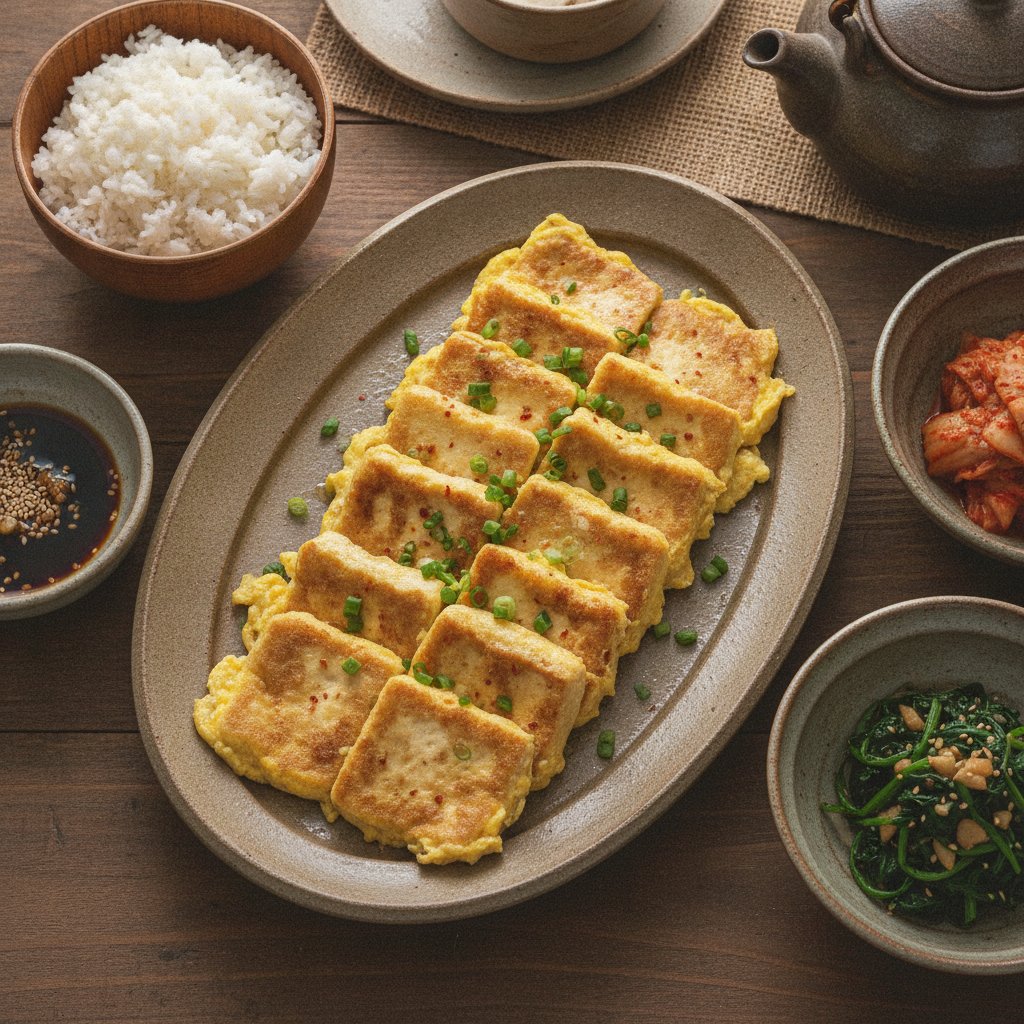
- Dip and fry over controlled heat: Heat 30 ml (2 tbsp) of neutral cooking oil in a large non-stick skillet over medium-low heat for about 2 minutes until warm but not smoking. Dip each floured tofu slab into the egg mixture, ensuring scallions and carrots cling to the top surface, then carefully lay the slab into the warm pan. Cook for 3 to 4 minutes on the first side until the underside is set and turns a delicate pale golden color. Flip gently with a wide spatula and fry the second side for another 2 to 3 minutes. Why you do this: Egg solids scorch quickly and turn bitter if exposed to high heat. Medium-low heat cooks the egg slowly, developing a smooth, appetizing yellow hue while allowing heat to penetrate fully to the center of the dense tofu.
- Mix the dipping sauce and serve immediately: While the tofu cooks, combine 15 ml (1 tbsp) soy sauce, 10 ml (2 tsp) rice vinegar, 15 ml (1 tbsp) water, 2 g (1/2 tsp) toasted sesame seeds, and 1 g (1/4 tsp) optional gochugaru in a small sauce dish. Transfer the golden tofu slices from the pan directly to a serving platter. Serve warm with the soy-vinegar sauce (*choganjang*) on the side.
Tips from a Korean Kitchen
In home kitchens across Seoul, every cook has small adjustments that elevate this dish from basic home food to something truly special. Here are four practical habits to keep in mind:
- Master the vegetable ratio: Resist the temptation to add too many minced vegetables to the egg batter. If the bowl is crowded with veggies, the liquid egg won’t seal around the edges of the tofu, causing the batter to break apart into scrambled bits beside the slice.
- Use a spoon to scoop garnishes: When transferring egg-dipped tofu to the pan, use a spoon to scoop up a few stray pieces of green onion and carrot from the bowl and gently lay them on top of each slab right after it hits the skillet. This gives you beautiful, evenly decorated pieces.
- Keep sesame oil out of the frying pan: Frying dubu jeon in pure toasted sesame oil is a common mistake. Sesame oil has a very low smoke point and will burn quickly, creating a sharp, acrid taste. Fry in a neutral oil like canola or vegetable oil instead. If you love the aroma of sesame, drizzle a tiny drop over the warm plated tofu right before serving.
- Don’t crowd the pan: Leave at least 1 cm (1/2 inch) of space between each slab of tofu in the skillet. If they touch, the soft egg batter will fuse the pieces together, and flipping them will tear the delicate golden crust.
Storage
Dubu jeon is best enjoyed immediately while warm and freshly fried. However, leftovers keep surprisingly well in an airtight container in the refrigerator for up to 3 days. The egg coating will naturally soften as it rests in the fridge. Do not freeze this dish; freezing breaks down the cellular structure of cooked tofu, turning it tough and spongy, while causing the egg batter to become watery upon thawing.
To reheat refrigerated dubu jeon, do not use a microwave, which turns the egg spongy and rubbery. Instead, heat a dry non-stick skillet over medium-low heat. Place the cold tofu slices in the pan without adding extra oil and warm for about 2 minutes per side until heated through and crisp on the surface.
🛒 Korean Pan Fried Tofu with Egg
As an Amazon Associate we earn from qualifying purchases.
Shop Ingredients & Tools →FAQ
Can I make Korean pan fried tofu with egg ahead of time for meal prep?
Yes, you can cook a batch in the morning or the day before to pack into lunchboxes or serve as a quick dinner side dish. While the egg coating loses its subtle pan-crispness once chilled, the flavor remains delicious. Reheat gently in a dry skillet over low heat for a few minutes to restore warmth and texture.
Why does the egg coating peel off my fried tofu?
The egg layer usually peels off for two reasons: wet tofu or skipping the flour step. Raw egg cannot stick to wet surfaces. Salting the tofu to draw out internal moisture, patting it thoroughly dry with paper towels, and applying a light dust coat of flour creates the necessary dry surface for the egg batter to grip onto firmly during frying.
What kind of tofu is best for Dubu Jeon?
Extra-firm or firm block tofu packaged in water (such as CJ or Pulmuone brands found at Asian markets, or standard supermarket firm tofu) is ideal. Soft or silken tofu breaks apart too easily during handling, while pre-dried or vacuum-sealed ultra-baked tofu lacks the juicy, tender interior contrast that makes traditional Korean pan-fried tofu so appealing.
More Korean Recipes
- Creamy Korean Corn Cheese (콘치즈)
- Gyeran Jjim (Korean Steamed Eggs): Always Fluffy
- Jangjorim Recipe: Authentic Korean Soy-Braised Beef and Eggs
- Eomuk Bokkeum (Stir-Fried Fish Cakes): Your New Favorite Lunchbox Side Dish
🛒 Korean Pan Fried Tofu with Egg
As an Amazon Associate we earn from qualifying purchases.
Shop Ingredients & Tools →