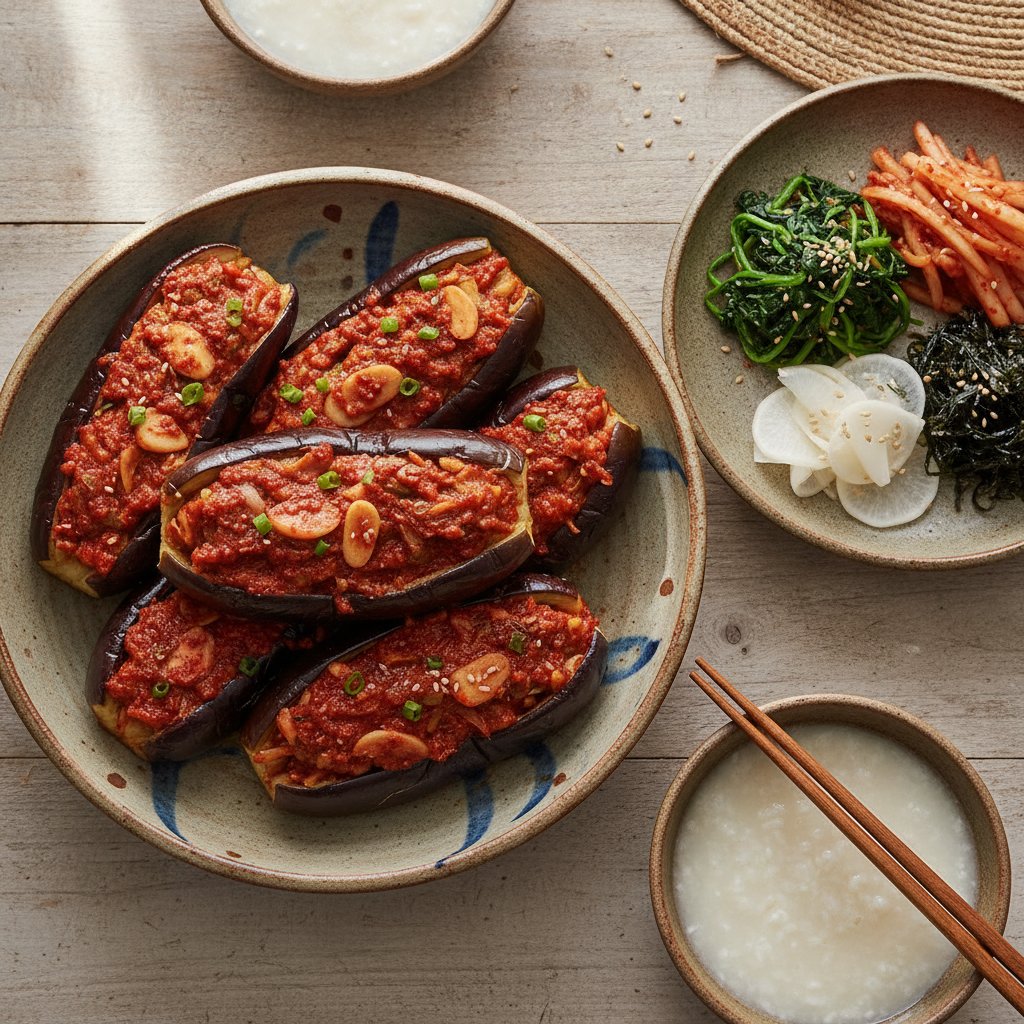
Gaji Kimchi (Korean Stuffed Eggplant Kimchi Recipe)
This post contains affiliate links. As an Amazon Associate, we earn from qualifying purchases at no extra cost to you.
At a glance
- In shortLearn how to make refreshing Korean stuffed eggplant kimchi with a spicy garlic chive stuffing.
- Best forHome cooks seeking a quick Korean summer kimchi recipe
- DifficultyMedium
- HeatMedium
- Key pointsBriefly steam eggplants to soften the center without making them mushy. · Salt and press eggplants to remove excess moisture and prevent dilution. · Cross-slit eggplants longitudinally to neatly hold the spicy filling.
- Heads-upAvoid over-steaming the eggplants so they hold their shape and do not turn into purée.
When July humidity hits Seoul and heat radiates off the concrete, my grandmother used to refuse to touch heavy napa cabbage for making kimchi. Cabbage becomes watery and limp in midsummer, but dark purple Asian eggplants are at their absolute peak—glossy, firm, and tender. In Korean home kitchens, this is when we make gaji kimchi (stuffed eggplant kimchi), a refreshing summer side dish designed to be eaten cold straight from the refrigerator alongside hot rice or cold noodles.
Unlike classic winter kimchi that ferments underground for months, gaji kimchi is a quick-cured summer variation. In my family, we treat it almost like a fresh salad pickle—what we call geotjeori (fresh unfermented kimchi)—though it will lightly ferment over a few days if left in the fridge. The flesh of the eggplant acts like a sponge, soaking up the sharp garlic, spicy chili, and fragrant garlic chives while retaining a crisp, juicy bite that completely transforms how people think about eggplant.
Why This Works
- Targeted steaming before stuffing: Briefly steaming the salting-cured eggplants cooks out raw bitterness and softens the center just enough to pocket the stuffing without turning the vegetable into mush.
- Cross-slit pocket technique: Cutting deep longitudinal slits while keeping the base and top intact preserves structural integrity, holding a generous amount of garlic chive filling neatly inside.
- Double moisture control: Salting followed by a gentle hand-press removes high water content, ensuring your spicy kimchi paste stays concentrated and punchy rather than watery.
- Balanced savory paste: Combining salted fermented shrimp with fish sauce provides immediate depth of flavor without requiring long fermentation times.
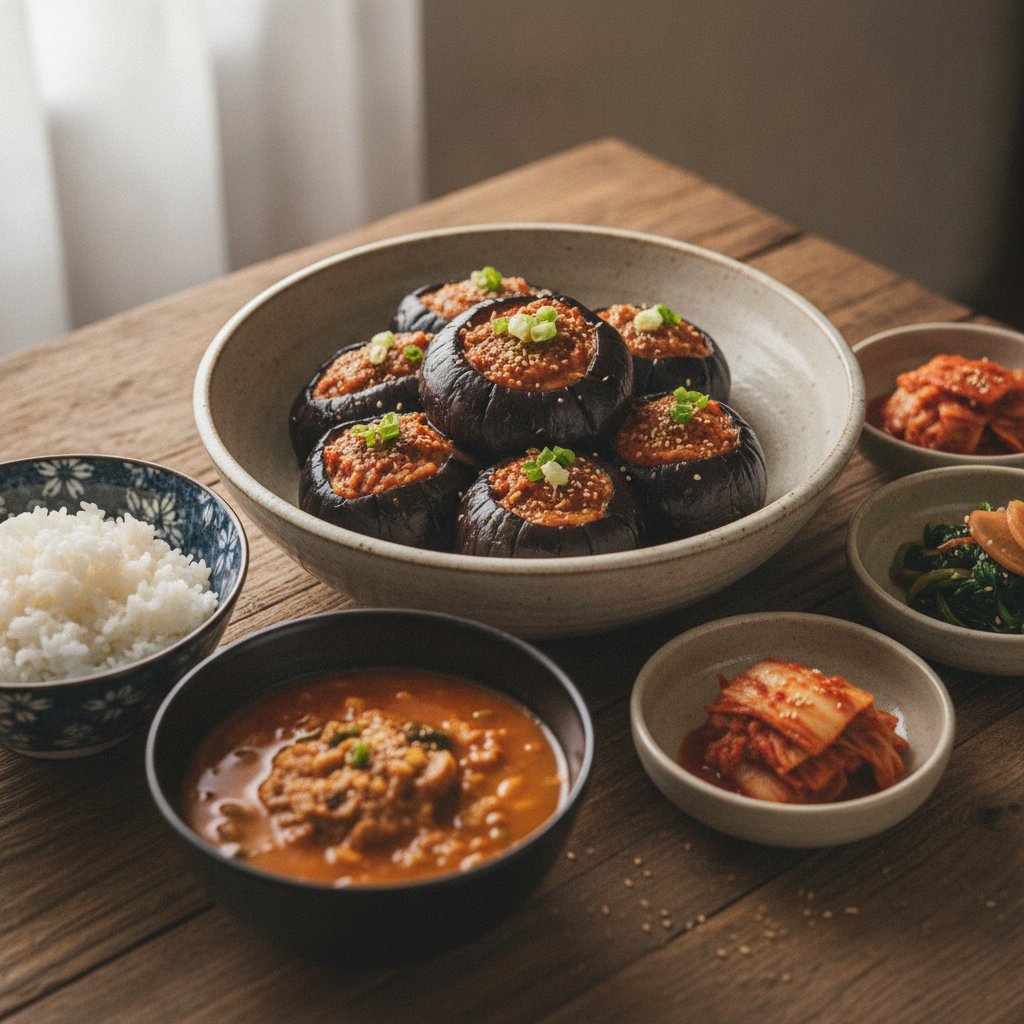
Ingredients
- 1 kg (about 2.2 lbs) small Korean eggplants or slender Asian eggplants (about 6 to 8 medium eggplants)
- 60 g (about 1/4 cup) coarse Korean sea salt (kkotsogem) for curing
- 150 g (about 2 packed cups) fresh buchu (garlic chives), trimmed and cut into 2-cm (1-inch) pieces
- 100 g (about 1 cup) Korean radish (mu) or daikon radish, peeled and shredded into fine matchsticks
- 50 g (about 1/2 cup) gochugaru (coarse Korean red pepper flakes)
- 45 ml (3 tbsp) myeolchi-aekjeot (Korean anchovy fish sauce)
- 30 g (about 2 tbsp) saeujeot (salted fermented shrimp), finely chopped
- 30 g (about 2 tbsp) garlic, finely minced
- 10 g (about 1 tbsp) fresh ginger, finely grated
- 15 g (about 1 tbsp) sugar or maesil-cheong (Korean green plum syrup)
- 60 ml (1/4 cup) kelp broth (water steeped with a 2-inch piece of dried dashima) or plain cold water
- 15 g (1 tbsp) toasted sesame seeds
Substitutions
If you cannot source every traditional ingredient at your local Asian market, these Western grocery store swaps work reliable wonders:
- Korean Eggplant: Look for slender Japanese or Chinese eggplants. Avoid large, round Western globe eggplants—their skin is too tough, seeds are too bitter, and the high moisture ratio makes them go soggy instantly. If you must use globe eggplants, quarter them lengthwise and cut into thick slices instead of stuffing them whole.
- Garlic Chives (Buchu): Substitute with standard green onions (scallions), thinly sliced, mixed with an extra half clove of finely grated garlic to mimic the sharp flavor profile of native garlic chives.
- Fermented Salted Shrimp (Saeujeot): Use an equal amount of additional anchovy fish sauce or fish sauce combined with a small pinch of fine sea salt. For a plant-based vegan alternative, swap both seafood sauces for Korean soup soy sauce (guk-ganjang) or a clear mushroom seasoning liquid like Yondu.
- Korean Red Pepper Flakes (Gochugaru): There is no direct Western equivalent. Do not use Western chili powder blends (which contain cumin and oregano) or cayenne pepper (which is far too spicy and lacks fruitiness). Look for mild coarse Korean chili flakes online or at a local Asian market; brands like CJ CheilJedang or Sempio are widely available.
How to Make It
- Prep and cut the eggplants: Wash eggplants thoroughly under cold water. Trim off the green cap at the stem end, leaving the stem top intact so the eggplant holds together. Make two long, perpendicular cuts through the belly of each eggplant—forming an ‘X’ shape longitudinally—stopping about 2 cm (1 inch) from both ends. Why: Keeping both ends connected creates a sturdy pocket that holds the dense stuffing securely inside during curing and handling.
- Salt cure the interior: Generously sprinkle coarse Korean sea salt into the cut slits and over the outer skin. Arrange eggplants in a wide tray and let them sit at room temperature for 20 to 25 minutes, gently turning them once halfway through. Why: Salt draws out trapped surface moisture, removes latent raw bitterness, and seasons the eggplant flesh all the way to its center.
- Briefly steam the eggplants: Rinse the salted eggplants quickly in cold water to remove excess surface salt, then drain. Set up a steamer basket over boiling water, place the eggplants inside, cover, and steam on high heat for exactly 3 to 4 minutes. Why: Steaming breaks down tough raw starches so the eggplant absorbs flavor quickly, but keeping the steam short preserves a structural snap so the kimchi does not turn into purée.
- Cool and drain thoroughly: Remove eggplants from the steamer and lay them cut-side down on a wire rack or clean kitchen towel. Allow them to cool completely for 15 minutes, then gently press each eggplant between your palms over the sink to squeeze out trapped juice and steam condensed water. Why: Excess waterdilutes your savory kimchi seasoning paste, causing the final dish to taste bland and spoil faster.
- Hydrate the kimchi paste: In a medium mixing bowl, combine gochugaru, anchovy fish sauce, chopped saeujeot, minced garlic, grated ginger, sugar (or plum syrup), and cold kelp broth. Stir well and let sit for 10 minutes. Why: Giving gochugaru time to soak up liquid hydrates the chili flakes, turning a dry spice into a rich, glossy paste that clings tightly to vegetables.
- Mix the vegetable stuffing: Add the shredded Korean radish, cut garlic chives, and toasted sesame seeds into the bowl with the hydrated kimchi paste. Toss gently by hand (wearing plastic kitchen gloves) until evenly coated. Why: Tossing gently prevents bruising delicate garlic chives, which can turn slimy or emit an unappealing metallic flavor if handled roughly.
- Stuff and pack the eggplants: Carefully pry open the cut slits of each eggplant. Pack a generous portion of the spicy chive mixture deep into the center pocket. Rub any leftover seasoning paste across the outer purple skin. Lay stuffed eggplants horizontally into an airtight glass container, pressing them down firmly to eliminate air pockets. Why: Removing trapped air prevents oxidation, preserving the vivid purple color of the skin and crisp texture of the filling.
Tips from a Korean Kitchen
In Korean homes, making eggplant kimchi is all about timing and moisture control. Here are four foundational secrets passed down through generations:
Watch the steamer like a hawk. The biggest mistake beginners make is overcooking the eggplant during the steaming phase. Eggplant flesh turns spongy and soft very quickly. The vegetable should feel pliable enough to bend without snapping, yet firm enough to hold its shape when pinched. If in doubt, err on the side of under-steaming.
Press out moisture gently, not aggressively. While removing excess water is crucial, squeezing too hard will tear the skin and crush the delicate interior flesh. Use the flat palms of your hands to apply even, gentle pressure along the length of the eggplant.
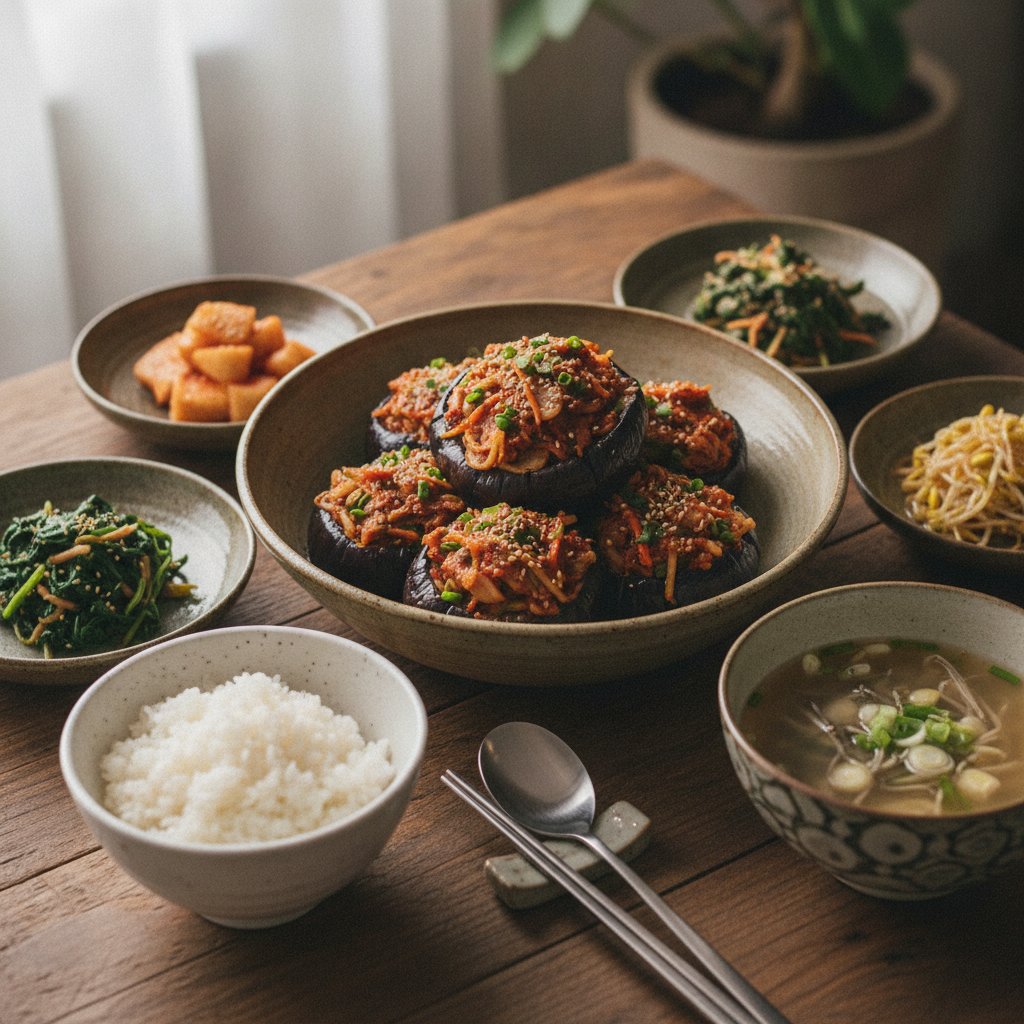
Slice before serving. When serving at the dinner table, do not serve the stuffed eggplants whole. Transfer a stuffed eggplant to a cutting board and slice it crosswise into bite-sized 3-cm (1-inch) rounds using a sharp knife. This reveals beautiful layers of dark purple skin, pale flesh, and bright green-and-red filling.
Match with simple, light meals. Because gaji kimchi offers a bright, herbaceous, and savory flavor profile, it pairs exceptionally well with light summer meals like kongguksu (chilled soy milk noodle soup), simple grilled pork belly (samgyeopsal), or just a steaming bowl of freshly steamed white rice with a drizzle of toasted sesame oil.
Storage
Unlike hearty napa cabbage or radish kimchi that can age in cold storage for months, gaji kimchi is best eaten fresh or lightly aged. Store the packed container in the coldest part of your refrigerator immediately after assembly.
| Storage Duration | Flavor Profile | Best Usage |
|---|---|---|
| Day 1 – 3 | Fresh, crisp, pungent garlic notes | Served cold as a fresh side dish (geotjeori) |
| Day 4 – 7 | Lightly tangy, soft, deep umami | Eaten with hot rice or cold noodles |
| Day 8+ | Very sour, soft texture | Chopped into pan-fried kimchi pancakes (kimchijeon) |
Do not freeze gaji kimchi. Freezing breaks down the high-water cellular structure of the eggplant, causing it to thaw into a soggy, unappealing liquid texture.
FAQ
Can I make an eggplant kimchi recipe without steaming the eggplants?
Yes, you can make raw gaji kimchi by extending the initial salting period to 45-60 minutes until the eggplants become completely soft and bendable. However, briefly steaming for 3 minutes yields a far superior texture that is tender yet pleasantly chewy rather than raw and tough.
How long should I ferment gaji kimchi at room temperature?
Do not leave eggplant kimchi at room temperature for extended fermentations like you would with cabbage. Because eggplant is soft and delicate, ambient summer heat can make it mushy within hours. Transfer it directly to the refrigerator right after stuffing. It will slowly develop a light, crisp sour note within 2 to 3 days in the cold.
Why did my eggplant kimchi turn dark brown instead of purple?
Eggplant skin contains natural pigments called anthocyanins that react to heat and oxygen. If overcooked or exposed to too much air, the purple skin turns brownish-grey. Squeezing air out of your storage container, keeping the steaming time short, and ensuring the eggplants are fully submerged under the kimchi liquid prevents color fading.
More on Vegetable & Fresh Kimchi
- Sweet Crunchy Bossam Kimchi RecipeLearn how to make sweet, crunchy Korean radish salad (musaengchae) for boiled pork wraps.
- Fresh Buchu Kimchi RecipeLearn how to make quick Korean garlic chive kimchi in under 30 minutes without pre-salting.
- Quick Oi Muchim (Cucumber Kimchi)A 15-minute recipe for making Quick Cucumber Kimchi (Oi Muchim), a fresh Korean side dish.
See every Vegetable & Fresh Kimchi post in our Kimchi guide.
Handy toolsRecipe scaler · Measurement converter · Korean pantry guide · Recipe Finder
More Korean Recipes
- Pan-Fried Kimchi Rice Balls (Kimchi Jumokbap)
- Kimchi Dubu Jorim: Spicy Braised Tofu with Kimchi
- Kimchi Kalguksu Recipe: Korean Knife-Cut Noodle Soup
- Crispy Kimchi Grilled Cheese (Kimchi Chijeu Tosteu)