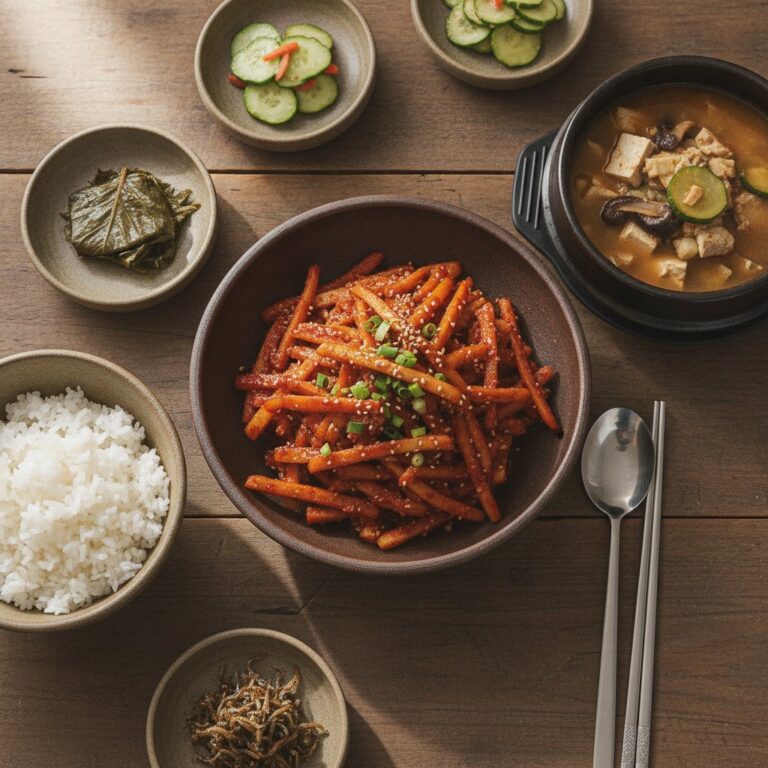
Melt-in-Your-Mouth Mu Jorim (Braised Korean Radish Recipe)
This post contains affiliate links. As an Amazon Associate, we earn from qualifying purchases at no extra cost to you.
At a glance
- In shortA guide to making authentic Korean braised radish (mu jorim) with stock, spices, and substitution options.
- Best forHome cooks wanting to make Korean braised radish
- DifficultyEasy
- HeatMild
- Key pointsKorean radish turns soft and sweet when braised low and slow. · Sliced onions at the bottom prevent scorching and add natural sweetness. · Daikon radish and vegetable broth can substitute traditional ingredients.
- Heads-upPour stock down the side of the pot to avoid washing seasonings off the top.
On chilly evenings in Seoul, my mother always kept a heavy stainless steel pot simmering gently on the back burner of our tiny kitchen. Long before you walked through the front door, the aroma would meet you in the hallway: a rich, comforting perfume of toasted sesame oil, deep soy sauce, and sweet braised root vegetables. Nine times out of ten, that pot held mu jorim (braised Korean radish).
In Korea, we have a common saying: winter radish is better than ginseng. During the cold months, Korean radish becomes incredibly dense, juicy, and naturally sweet. While many people outside Korea know radish only as a crisp raw crunch in salads, braising it transforms this humble vegetable entirely. The sharp bite vanishes, replaced by a silky, melt-in-your-mouth texture that soaks up savory broth like a sponge.
This dish is a cornerstone of daily jipbap (home-cooked Korean meals). It is budget-friendly, incredibly simple to prepare, and tastes even better the next day. Whether served as a humble banchan (side dish) alongside a steaming bowl of fresh white rice or prepared as the bed for braised fish, master this basic radish braise and you unlock one of the most authentic flavors of traditional Korean home cooking.
Why This Works
- Aromatic heat cushion: Layering sliced onions at the bottom of the pot creates a physical barrier that prevents the radish from burning during a long simmer while releasing natural sugars directly into the cooking liquid.
- Two-phase cooking technique: Braising covered first breaks down tough plant pectin until tender, while a final uncovered reduction coats each piece in a rich, glossy soy glaze.
- Dashi-infused depth: Using a quick dried kelp and anchovy stock instead of plain water delivers natural glutamates (umami) straight to the center of the radish chunks.

Ingredients
To make traditional home-style mu jorim (braised Korean radish), you will need the following ingredients. Measurements are provided in both metric and US custom units for accuracy.
- 800 g (about 1.75 lbs) Korean radish (mu): Peeled and cut into 2 cm (3/4-inch) thick rounds or half-moons.
- 500 ml (about 2 cups) Korean anchovy-kelp stock: Made by simmering dried anchovies and dashima (dried kelp) in water for 10 minutes, or prepared using commercial stock coins.
- 100 g (about 1 medium) yellow onion: Thickly sliced.
- 3 stalks green onion: Cut into 5 cm (2-inch) segments, divided.
- 1 fresh red chili pepper (optional): Thinly sliced on a diagonal for color and subtle heat.
- 4 tbsp (60 ml) soy sauce: Regular Korean soup soy sauce or naturally brewed soy sauce (such as Sempio brand).
- 1.5 tbsp (10 g) Korean chili flakes (gochugaru): Adjust to taste depending on preferred spice level.
- 1 tbsp (15 ml) toasted sesame oil: Added for nutty richness.
- 1 tbsp (15 ml) rice syrup (joenting) or corn syrup: Adds shine and a gentle sweetness (or substitute brown sugar).
- 1 tbsp (15 g) minced garlic: Freshly minced for maximum flavor.
- 1 tsp (5 g) freshly grated ginger: Balances the earthy tones of the radish.
- 1 tbsp (15 ml) mirin: Korean or Japanese rice wine to smooth out flavor edges.
Substitutions and Swaps
If you shop primarily at Western supermarkets, a few authentic Korean ingredients might require easy adjustments:
- Korean Radish (mu) vs. Japanese Daikon: True Korean radish is rounder, firmer, and sweeter with a distinct pale green top. However, long Japanese daikon radish is widely available at regular grocery stores and works wonderfully here. Reduce cooking time by 5 to 8 minutes, as daikon contains more water and softens faster than Korean radish.
- Anchovy-Kelp Stock: If you cannot source dried soup anchovies or dashima (dried kelp), substitute with mild vegetable broth, diluted low-sodium chicken broth, or water mixed with 1/2 teaspoon of dashi powder (Japanese fish stock pellet). Plain water works in a pinch, but you may need an extra splash of soy sauce for depth.
- Korean Chili Flakes (gochugaru): Standard red pepper flakes from Western spice aisles are far harsher and spicier than gochugaru, which has a smoky, mildly sweet profile. If substituting, use half the amount of standard red pepper flakes or swap with mild Aleppo pepper powder.
| Ingredient | Traditional Korean | Western Grocery Swap |
|---|---|---|
| Main Vegetable | Korean Mu | Daikon Radish |
| Soup Base | Anchovy-Kelp Broth | Vegetable or Chicken Broth |
| Chili Flavor | Gochugaru | Aleppo Pepper / Mild Flakes |
How to Make It
-
Prep the radish chunks: Wash and peel 800 g (1.75 lbs) of radish. Cut the radish into thick rounds about 2 cm (3/4-inch) thick, then slice each round in half to make large half-moons.
Why: Cutting the radish into substantial, thick chunks ensures that it can withstand 40 minutes of gentle simmering without breaking down into a mushy pulp. Large pieces retain their structural integrity while absorbing sauce deeply. -
Build the aromatic bed: In a wide, heavy-bottomed pot or braising pan, spread the sliced yellow onions and half of the green onion segments evenly across the bottom.
Why: The moisture from the onions prevents the radish from sticking directly to the metal bottom and scorching during long cooking. As the onions break down, their natural sugars carmelize and flavor the simmering broth. -
Layer the radish and mix the sauce: Arrange the cut radish pieces over the onions in a single or slightly overlapping layer. In a small bowl, whisk together 4 tbsp soy sauce, 1.5 tbsp gochugaru, 1 tbsp minced garlic, 1 tsp grated ginger, 1 tbsp rice syrup, 1 tbsp mirin, and 1 tbsp toasted sesame oil until blended.
Why: Pre-mixing seasonings guarantees that the garlic, ginger, and chili flakes distribute uniformly across every piece of radish rather than clumping in one spot. -
Pour sauce and stock: Spoon the sauce mixture evenly over the top of the arranged radish pieces. Carefully pour 500 ml (2 cups) of anchovy-kelp stock down the side of the pot so you do not wash all the seasonings off the top of the radish.
Why: Pouring along the inner wall keeps the spice coating intact on top of the radish while allowing the broth to mingle with the bottom seasonings smoothly. -
Cover and simmer low and slow: Set the pot over medium-high heat. Bring the liquid to a rolling boil (about 4 to 5 minutes). Once boiling, immediately drop the heat to medium-low, cover tightly with a lid, and simmer undisturbed for 30 to 35 minutes.
Why: Trapping steam under a tight lid creates a convection environment that softens dense vegetable fibers evenly. Cooking low and slow allows the radish cell walls to relax and absorb broth without rupturing. -
Check tenderness and reduce sauce: Remove the lid. Insert a wooden chopstick or skewer into the center of the thickest radish chunk; it should slide in smoothly with no hard resistance. Add the remaining green onions and sliced red chili pepper. Increase heat slightly to medium.
Why: Uncovering the pot allows excess moisture to evaporate so the thin broth transforms into a slightly glossy, clinging glaze. -
Baste and finish: Cook uncovered for 5 to 7 minutes, frequently spooning the bubbling simmer sauce over the tops of the radish pieces until the liquid reduces by roughly half and turns a deep reddish-brown color. Remove from heat and serve warm.
Why: Basting gives the finished dish a shiny, dark glaze and coats every piece evenly right before serving.

Tips from a Korean Kitchen
Making outstanding mu jorim relies on small, classic techniques passed down through generations of home cooks. Keep these practical pointers in mind:
- Trim sharp edges for presentation: If you want your dish to look like it came from a traditional Seoul restaurant, take a paring knife and lightly bevel (round off) the sharp cut edges of each radish piece. Smooth corners prevent the radish from chipping off into the braising liquid as it bubbles, keeping your pan sauce clean and smooth.
- Adjust sugar for seasonal bitterness: Korean radishes harvested in late spring or summer contain more sulfur compounds and can taste slightly bitter compared to sweet winter crops. If you are making this dish outside of autumn or winter, taste a raw piece of radish first. If it bites back with bitterness, add an extra 1/2 teaspoon of brown sugar or rice syrup to the braising liquid.
- Choose a wide pan over a deep pot: A wide braising pan or shallow Dutch oven works much better than a tall, narrow soup pot. You want as many radish pieces as possible touching the bottom or second layer so every piece braises evenly in the liquid.
- Let it rest before serving: While it is tempting to serve mu jorim piping hot straight off the stove, resting it for 10 to 15 minutes off the heat allows the radish to draw remaining pan juices back into its core, maximizing tenderness and flavor.
Storage and Reheating
One reason Korean families love braised radish is that it stores remarkably well. In fact, many cooks prefer eating it the next day after the flavors have fully settled.
- Refrigerator: Transfer leftover radish and broth into a clean glass container with a tight lid. Store in the fridge for up to 5 days. Glass is preferred over plastic, as gochugaru and soy sauce can stain light plastic containers.
- Freezer: Freezing is not recommended for braised radish. Freezing ruptures the water-filled cellular matrix of cooked radish, causing it to become stringy, spongy, and unpleasantly watery upon thawing.
- Reheating: Place desired portions into a small saucepan with 2 to 3 tablespoons of fresh water to replace evaporated moisture. Cover and simmer over medium-low heat for 5 to 6 minutes until heated through. Alternatively, microwave covered for 1.5 to 2 minutes on high heat.
FAQ
Can I make mu jorim without anchovy stock?
Yes, absolutely. While traditional recipes rely on dried anchovy and kelp stock for authentic depth, you can easily use vegetable stock or simple mushroom water (water from soaking dried shiitake mushrooms). If using plain water, consider adding 1/2 teaspoon of light soy sauce or a splash of fish sauce to replace the missing umami notes.
What is the difference between Korean radish (mu) and Japanese daikon?
Korean radish (mu) is short, thick, round, and firm with a pale green coloration spanning the top third of the skin. It has a dense texture and sweet, crisp flavor. Japanese daikon is longer, thinner, uniformly white, and contains higher water content. Daikon works well in this recipe, but cooks slightly faster and turns softer than Korean radish.
Is mu jorim served hot or cold?
Mu jorim is extremely versatile and can be enjoyed warm, at room temperature, or chilled straight from the refrigerator. During cold winter months, serving it warm alongside hot soup and rice is most common. In hot summer weather, cold braised radish served direct from the fridge offers a refreshing, savory side dish.
More on Braised Side Dishes
- Korean Sweet Soy Braised PeanutsLearn how to make authentic Korean sweet soy braised peanuts with a glossy, non-sticky glaze.
- Gamja Jorim: Korean Braised PotatoesLearn how to make Gamja Jorim, a classic sweet and savory Korean braised potato side dish.
- Authentic Dubu Jorim (Korean Braised Tofu)A simple home-style recipe for Dubu Jorim, a savory and spicy Korean braised tofu banchan.
See every Braised Side Dishes post in our Banchan guide.
Handy toolsRecipe scaler · Measurement converter · Korean pantry guide · Recipe Finder
More Korean Recipes
- Spicy Seasoned Yellow Radish (Danmuji Muchim)
- Soy Pickled Perilla Leaves (Kkaennip Jangajji) Recipe
- Yangpa Jangajji Recipe: Easy Korean Pickled Onions
- Dubu Gangjeong: Korean Sweet and Spicy Tofu Recipe